Safeguarding Growth: Managing Human Capital Risks in the Halal Industry
DOI:
https://doi.org/10.55265/halalreviews.v5i1.143Keywords:
Halal Industry, Enterprise Risk Management, Human Capital Risk, Risk Culture, Halal GovernanceAbstract
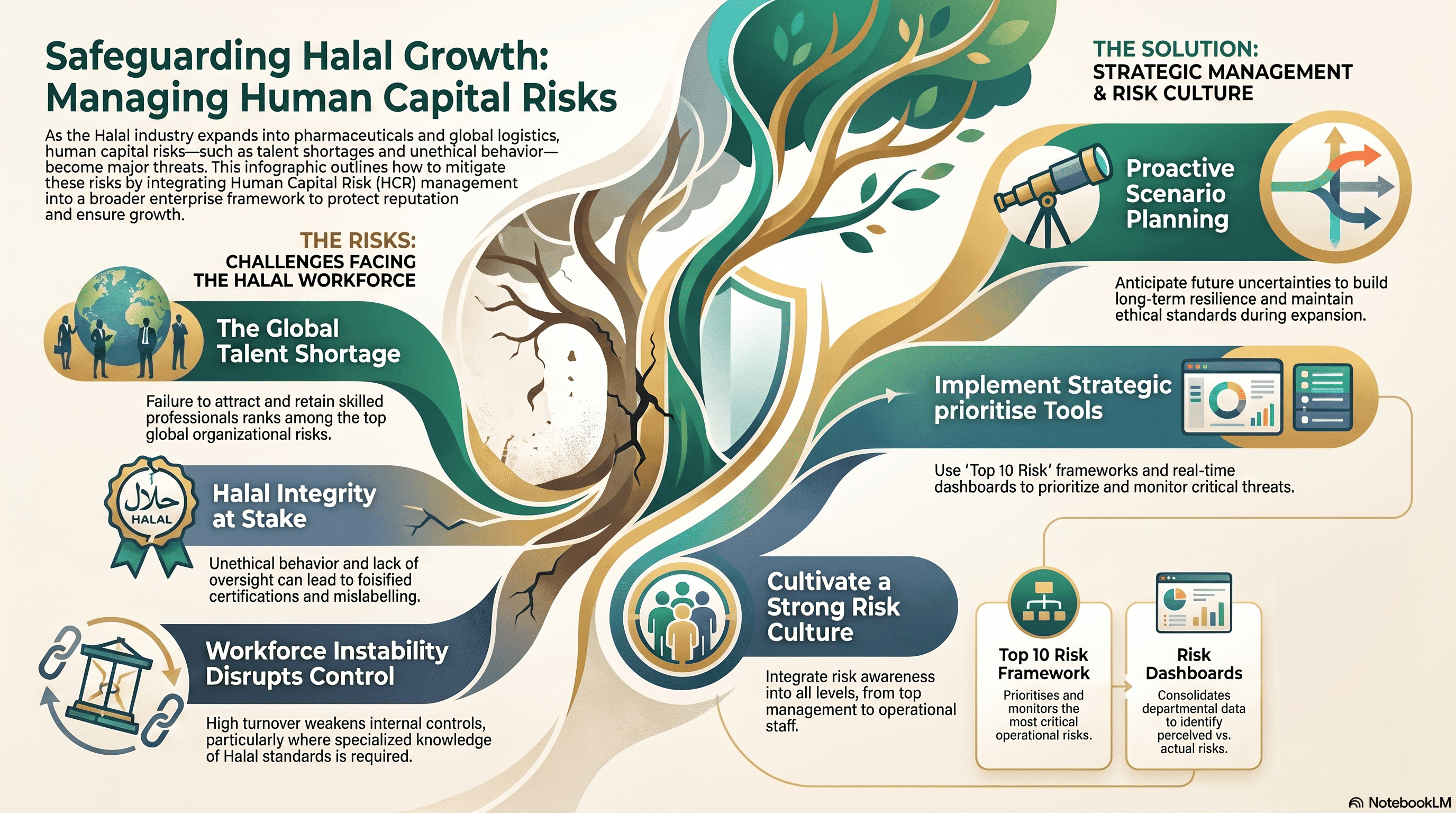
This study examines the role of enterprise risk management (ERM) in safeguarding sustainable growth within the Halal industry, with a particular focus on human capital risk. As the industry expands into complex and highly regulated sectors such as pharmaceuticals, logistics, and global trade, organizations face increasing challenges related to workforce capability, compliance, and operational integrity. This paper conceptualizes human capital risk as a critical component of enterprise risk, encompassing issues such as talent shortages, skill gaps, employee turnover, and ethical vulnerabilities. Drawing on contemporary risk management frameworks and Halal industry dynamics, the study highlights how deficiencies in human capital can lead to systemic failures, including non-compliance, fraud, and reputational damage. It further explores the implications of operating in a volatile, uncertain, complex, and ambiguous (VUCA) environment, where technological advancement and globalization intensify risk exposure. The paper proposes strategic approaches to mitigate these risks, including the development of a strong risk culture, implementation of tools such as risk dashboards and scenario planning, and prioritization of workforce development and governance structures. The findings suggest that integrating ERM with human capital strategies is essential for enhancing organizational resilience, maintaining Halal integrity, and achieving long-term sustainability. Ultimately, the study underscores that effective risk management in the Halal industry must extend beyond compliance to encompass the ethical, technical, and human dimensions of organizational performance.
Downloads
References
Arif, S., Fazila, N. S., & Mat, Z. (2025). The significance of halal knowledge: Unveiling its influence on halal controller performance. International Journal of Academic Research in Economics and Management Sciences, 14(3). https://doi.org/10.6007/IJAREMS/v14-i3/25980
Belás, J., Zvaríková, K., Maroušek, J., & Metzker, Z. (2021). The perception of significant aspects of personnel risk in the management of SMEs. Ekonomicko-Manazerske Spektrum, 15(2), 1–12. https://doi.org/10.26552/ems.2021.2.1-12
Damanpak, A., Rizi, A., Roy, A., Noor, R., Kang, H., Varshney, N., Jacob, K., Rivera-Jimenez, S., Edwards, N., Sorger, V. J., Dalir, H., & Asadizanjani, N. (2023). From talent shortage to workforce excellence in the CHIPS Act era: Harnessing Industry 4.0 paradigms for a sustainable future in domestic chip production.
Dang-Pham, D., Hoang, A.-P., Vo, D.-T., & Kautz, K. (2022). Digital Kaizen: An approach to digital transformation. Australasian Journal of Information Systems, 26. https://doi.org/10.3127/ajis.v26i0.3851
Datti, L. C., & Kuppusamy, M. (2023). An empirical analysis of the capabilities for digital transformation resilience in selected countries. International Journal of Professional Business Review, 8(8). https://doi.org/10.26668/businessreview/2023.v8i8.2627
Dürst, N., & Kunz, J. (2025). Embedding risk culture in a financial institution: An action research perspective. Review of Managerial Science. https://doi.org/10.1007/s11846-025-00946-2
Filemon, T., Lubbe, S., & Mynhardt, H. (2024). The assessment of risk management in human resources practices in the public sector. SocioEconomic Challenges, 8(2), 342–359. https://doi.org/10.61093/sec.8(2).342-359.2024
Fitriani, F., Wahab, A., & Hendratmi, A. (2025). Leadership in halal business sector: Bibliometric analysis and a roadmap for future research. Journal of Leadership in Organizations, 7(2), 138. https://doi.org/10.22146/jlo.103552
Hardy, C., Maguire, S., Power, M., & Tsoukas, H. (2020). Organizing risk: Organization and management theory for the risk society. Academy of Management Annals, 14(2), 1032–1066. https://doi.org/10.5465/annals.2018.0110
Jamil, S. N., Aziz, M. I., & Abdullah, A. (2025a). Application of meta analysis approach towards determining talent shortage in Islamic banking institution. Advanced International Journal of Business Entrepreneurship and SMEs, 7(23), 76–89. https://doi.org/10.35631/aijbes.723007
Jamil, S. N., Aziz, M. I., & Abdullah, A. (2025b). The use of meta-analysis to examine talent shortage dynamics in Islamic banking institutions. Journal of Entrepreneurship and Business, 13(2), 42–55. https://doi.org/10.17687/263yka46
Kotásková, A., Belás, J., Bilan, Y., & Khan, K. A. (2020). Significant aspects of managing personnel risk in the SME sector. Management & Marketing, 15(2), 203–218. https://doi.org/10.2478/mmcks-2020-0013
Kotlyk, A., Liu, L., & Liu, Y. (2024). The role of entrepreneurial leadership in securing the enterprise success in conditions of uncertainty. Успіхи і Досягнення у Науці. https://doi.org/10.52058/3041-1254-2024-8(8)-226-236
Krisyanti, B. M. C., Sitepu, R., Saputro, D. A., Dwita, F. P., & Gobai, D. W. (2025). The influence of organizational culture and risk aware culture on operational risk management. Zenodo. https://doi.org/10.5281/zenodo.18569359
Kuděj, M., Civelek, M., Erben, M., Masárová, J., & Kubálek, J. (2023). Navigating global markets: The role of enterprise risk management and human resource management in SME international expansions. Equilibrium Quarterly Journal of Economics and Economic Policy, 18(4), 1075–1103. https://doi.org/10.24136/eq.2023.034
Mabaso, C., & Ontong, A. (2025). Advancing economic growth through human capital development in the era of the Fourth Industrial Revolution. SA Journal of Human Resource Management, 23. https://doi.org/10.4102/sajhrm.v23i0.3080
Malaysian code on corporate governance. (2021).
Manas, N., Zakuan, N., Saman, M. Z. M., & Setapa, M. (2024). Enterprise risk management practices in Malaysian small and medium-sized enterprises: An overview. Information Management and Business Review, 16, 236–250. https://doi.org/10.22610/imbr.v16i2(i)s.3683
Mustaniroh, S. A., Sucipto, S., Pujiastuti, Y., Prabaningtias, N., Saputri, R., Koentjoro, M. P., & Rahma, R. A. (2025). Enhancing the halal potato chips supply chain: Innovative risk mitigation strategies for sustainable growth. Eastern-European Journal of Enterprise Technologies, 1, 17–26. https://doi.org/10.15587/1729-4061.2025.316197
Ogedengbe, D. E., Olatoye, F. O., Oladapo, J. O., Nwankwo, E. E., Soyombo, O. T., & Scholastica, U. C. (2024). Strategic HRM in the logistics and shipping sector: Challenges and opportunities. International Journal of Science and Research Archive, 11(1), 2000–2011. https://doi.org/10.30574/ijsra.2024.11.1.0269
Olawale, O., Ajayi, F. A., Udeh, C. A., & Odejide, O. A. (2024). Risk management and HR practices in supply chains: Preparing for the future. Magna Scientia Advanced Research and Reviews, 10(2), 238–255. https://doi.org/10.30574/msarr.2024.10.2.0065
Rizana, A. F., Wiratmadja, I. I., & Akbar, M. (2025). Exploring capabilities for digital transformation in the business context: Insight from a systematic literature review. Sustainability, 17(9), 4222. https://doi.org/10.3390/su17094222
Salam, S. A., Mohd, H., Muflih, B. K., & Jaiyeoba, H. B. (2023). Halal industry and standardization. Ekonomski Izazovi, 12(24), 20–30. https://doi.org/10.5937/ekoizazov2324020s
Sari, T. M., & Dini, W. (2023). Risk assessment and mitigation strategy in the halal broiler supply chain. Jurnal Riset Ilmu Teknik, 1(1), 13–24. https://doi.org/10.59976/jurit.v1i1.5
Sarwar, A., Zafar, A., & Qadir, A. (2021). Analysis and prioritization of risk factors in the management of halal supply chain management. Discover Sustainability, 2(1). https://doi.org/10.1007/s43621-021-00039-6
Sharma, D., & Nama, D. K. (2024). Embracing uncertainty. In Advances in logistics, operations, and management science book series (pp. 60–77). Routledge. https://doi.org/10.4018/979-8-3693-2125-6.ch004
Snippe, L., & Kara, A. (2023). Strategic risk leadership and sustainability in an ever changing environment. Studies in Risk and Sustainable Development, 397, 1–18. https://doi.org/10.22367/srsd.2023.397.3
Soud, M. A., Ogolla, D., & Mureithi, S. (2020). Relationship between talent management practices and organizational performance in Islamic banks in Kenya. International Journal of Research -GRANTHAALAYAH, 8(3), 98–114. https://doi.org/10.29121/granthaalayah.v8.i3.2020.133
Sridevi, D. (2024). The power of employee engagement: Unlocking the full potential of workforce in electronic industry of Tamil Nadu. African Journal of Biomedical Research, 6130–6137. https://doi.org/10.53555/ajbr.v27i3s.3493
Talim, B., & Alijoyo, F. A. (2026). Identifying and mapping human capital risk in the state-owned enterprises organization: Evidence from PT Pupuk Indonesia. Jurnal Ilmiah Akuntansi Kesatuan, 14(1), 313–326. https://doi.org/10.37641/jiakes.v14i1.4812
Tewu, M. L. D., Suwarno, S., Lisdiono, P., Friska, R., & Pramono, A. J. (2024). Enterprise risk management and supply chain management: The mediating role of competitive advantage and decision making in improving firms performance. Uncertain Supply Chain Management, 12(2), 1131–1140. https://doi.org/10.5267/j.uscm.2023.11.021
Umar, R., & Parakkasi, I. (2025). A risk-based auditing framework for halal certification systems: Bridging gaps in the current halal assurance practices. Formosa Journal of Science and Technology, 4(6), 1785–1804. https://doi.org/10.55927/fjst.v4i6.137
Voak, A., & Fairman, B. (2021). Building human capability to ensure halal supply chain compliance. In Routledge eBooks (pp. 1–6). Informa. https://doi.org/10.1201/9781003189282-1
Voak, A., Fairman, B., & Wahyuni, H. C. (2023). Halal supply chain competencies. Journal of Resilient Economies, 3(2). https://doi.org/10.25120/jre.3.2.2023.4021
Xikmatullayevich, K. J., & Mahmudovna, T. M. (2024). Issues of effective use of human resources in risk management and its general techniques. Journal of Advances in Accounting Economics and Management, 2(2). https://doi.org/10.47134/aaem.v2i2.483
Yoon, I., Lee, H., Choi, D.-J., & Jee, E.-S. (2023). Quantitative and qualitative investments in internal control personnel and firm operational efficiency: Evidence from Korea. Investment Management and Financial Innovations, 20(3), 273–284. https://doi.org/10.21511/imfi.20(3).2023.23
Downloads
Published
How to Cite
Issue
Section
License
Copyright (c) 2025 Anita Esa

This work is licensed under a Creative Commons Attribution-NonCommercial-ShareAlike 4.0 International License.