Minimising Costs in Global Halal Retail & Sustainable Hospitality While Impacting Halal Brands
DOI:
https://doi.org/10.55265/halalreviews.v5i1.142Keywords:
Halal Retail, Digital Transformation, Halal Hospitality, MSMEs, Vending Machine EcosystemAbstract
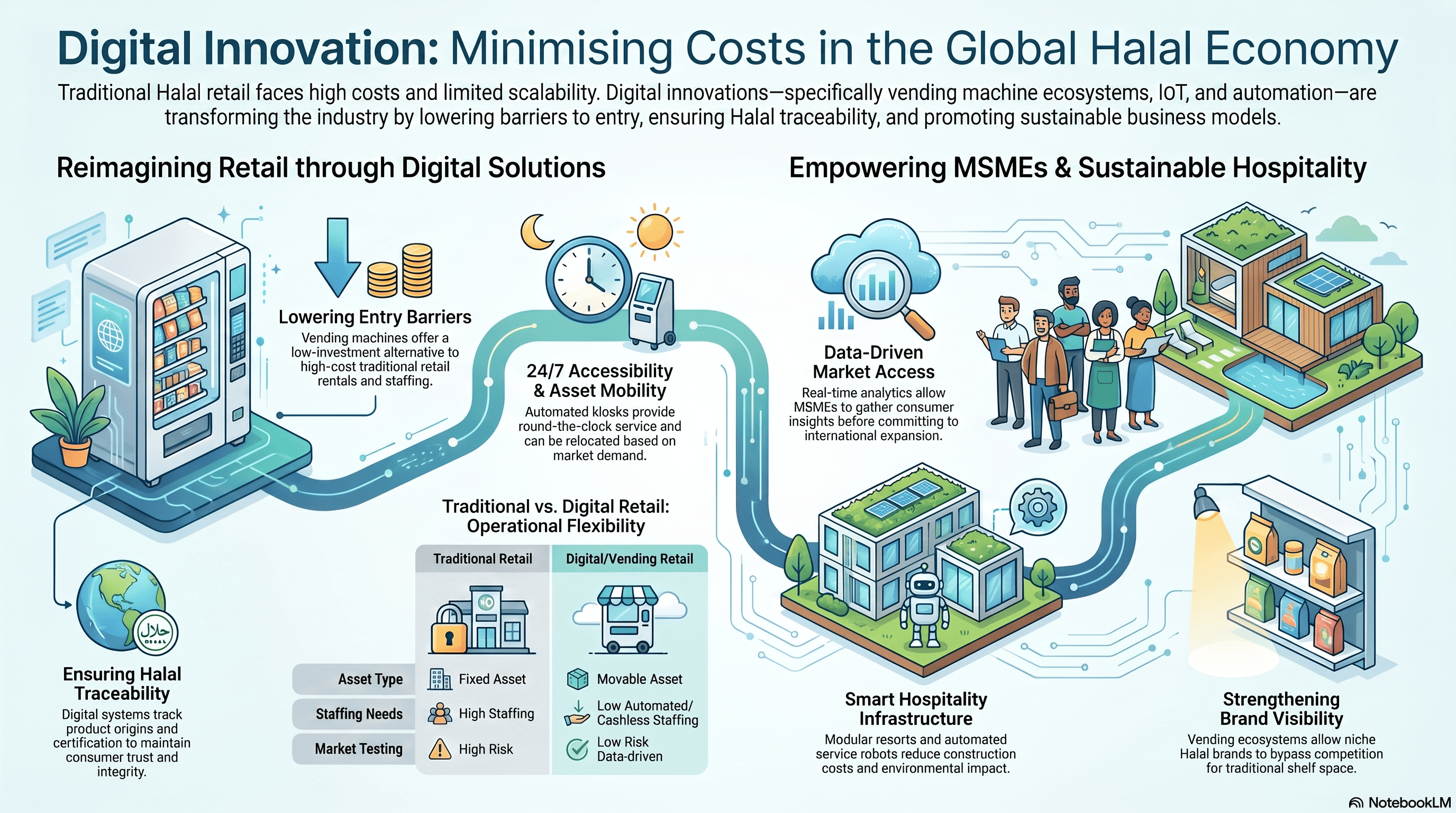
This study explores the role of digital innovation in transforming the global Halal retail and hospitality sectors, with a particular focus on cost efficiency, sustainability, and market accessibility. As the Halal industry expands in scale and complexity, traditional retail models face increasing challenges related to high operational costs, limited scalability, and inefficiencies in distribution. This paper examines how emerging technologies—such as vending machine ecosystems, Internet of Things (IoT), automation, and data analytics—offer alternative solutions that enhance operational efficiency while maintaining Halal compliance. The study highlights how digital retail platforms enable micro, small, and medium enterprises (MSMEs) to enter the market with lower capital investment, improve brand visibility, and access new consumer segments. It further discusses the integration of smart infrastructure and automation in both retail and hospitality contexts, emphasizing their role in reducing labor dependency, optimizing resource utilization, and supporting sustainable business practices. In addition, the paper addresses critical considerations such as Halal traceability, certification verification, and regulatory compliance, which are essential for maintaining consumer trust in a digital environment. While digital transformation presents significant opportunities, challenges related to logistics, compliance consistency, and infrastructure deployment remain. The findings suggest that the adoption of technology-driven retail and hospitality models can significantly enhance the competitiveness and sustainability of the Halal industry. By integrating innovation with ethical and regulatory standards, businesses can achieve scalable growth while preserving Halal integrity in a rapidly evolving global market.
Downloads
References
Alam, W., Sarma, D., Chakma, R. J., Alam, M. J., & Hossain, S. (2021). Internet of Things based smart vending machine using digital payment system. Indonesian Journal of Electrical Engineering and Informatics (IJEEI), 9(3). https://doi.org/10.52549/ijeei.v9i3.3133
Amnas, M. B., Selvam, M., & Parayitam, S. (2024). FinTech and financial inclusion: Exploring the mediating role of digital financial literacy and the moderating influence of perceived regulatory support. Journal of Risk and Financial Management, 17(3), Article 108. https://doi.org/10.3390/jrfm17030108
Andespa, R., Yurni, Y., Aldiyanto, A., & Efendi, G. (2024). Challenges and strategies in halal supply chain management for MSEs in West Sumatra: A participatory action research study. International Journal of Safety and Security Engineering, 14(3), 907–921. https://doi.org/10.18280/ijsse.140322
Arbansyah, A., Rahim, A., Barito, R. A., Nurdin, A. A., Ilham, M., & Latipah, J. (2025). Strategies for halal product validation and MSME collaboration to enhance the competitiveness of local snacks in the digital era. Journal of Empowerment and Community Service (JECSR), 4(2), 28–36. https://doi.org/10.53622/jecsr.v4i2.356
Asmara, M. A., Arissaputra, R., Sabila, S. N., & Aprila, D. S. (2025). Halal certification and branding: Unlocking the potential of SMEs in the Islamic economy. Jurnal Pengabdian UNDIKMA, 6(2), 258–268. https://doi.org/10.33904/jpu.v6i2.14990
Azroh, D. A., Ma’ruf, A., & Kholis, N. (2025). Sharia-based global trade for empowering Southeast Asian MSMEs: Challenges and strategic pathways. International Journal of Management and Economics Invention, 11(06). https://doi.org/10.47191/ijmei/v11i6.05
Benjamin, L. B., Amajuoyi, P., & Adeusi, K. B. (2024). Leveraging data analytics for informed product development from conception to launch. GSC Advanced Research and Reviews, 19(2), 230–248. https://doi.org/10.30574/gscarr.2024.19.2.0180
Biradar, P., Upendra, C. K., K, R. V., Nithin, S., & Suguna, A. (2024). Smart vending machine with auto-return mechanism. https://doi.org/10.59544/npwt8967/icrcct24p28
Chantarungsri, C., & Alam, A. (2025). Sustainable strategies for halal tourism infrastructure in the digital age: Integrating architecture, urban planning, and technology. Proceeding ISETH (International Summit on Science Technology and Humanity), 165–179. https://doi.org/10.23917/iseth.5358
Cheumar, M., & Abdullah, N. (2025). Towards Halal 5.0: A conceptual model of technological innovation and quality governance for global halal ecosystems. International Journal of Academic Research in Business and Social Sciences, 15(11). https://doi.org/10.6007/ijarbss/v15-i11/26991
Ellahi, R. M., Wood, L. C., Khan, M., & Bekhit, A. E. A. (2025). Integrity challenges in halal meat supply chain: Potential Industry 4.0 technologies as catalysts for resolution. Foods, 14(7), Article 1135. https://doi.org/10.3390/foods14071135
Fadhillah, A. A., & Saputra, R. P. (2025). Systematic review: Comparison of halal regulations in Asia. Journal of Halal Science and Research, 6(2), 134–146. https://doi.org/10.12928/jhsr.v6i2.12111
Fernandes, D. (2020). The role of digital payment systems in transforming retail commerce. https://doi.org/10.25215/9358091800.06
Ghule, P., Mane, V., Revankar, V., & Pusegaonkar, A. (2024). Versatile smart carts: Redefining the retail experience. International Journal for Research in Applied Science and Engineering Technology, 12(5), 1348–1351. https://doi.org/10.22214/ijraset.2024.61814
Ham, D.-W., Lindon, M., Tingley, M. P., & Bojinov, I. (2023). Design-based confidence sequences: A general approach to risk mitigation in online experimentation. SSRN. https://doi.org/10.2139/ssrn.4472576
Hendrawan, S. A., Chatra, A., Iman, N., Hidayatullah, S., & Suprayitno, D. (2024). Digital transformation in MSMEs: Challenges and opportunities in technology management. Jurnal Informasi dan Teknologi, 141–149. https://doi.org/10.60083/jidt.v6i2.551
Hidayat, Y., Machmud, A., Zulhuda, S., & Suartini, S. (2024). Legal aspects and government policy in increasing the role of MSMEs in the halal ecosystem. F1000Research, 13, Article 722. https://doi.org/10.12688/f1000research.148322.2
Jaaffar, A. H., Majid, N. A., Kasavan, S., Isa, A., Alwi, M. N. R., & Zahari, A. R. (2024). The effect of innovative mindset and behavior on innovation performance and competitive advantage: A case of halal SMEs owner-managers from Malaysian energy-intensive industry. Journal of Innovation and Entrepreneurship, 13(1). https://doi.org/10.1186/s13731-023-00359-z
Masood, A., & Lee, U. H. M. S. (2024). Securing halal integrity resilience of halal meat ecosystem for Society 5.0 needs through IR4.0 technologies. International Journal of Religion, 5(12), 541–557. https://doi.org/10.61707/64t65s36
Masood, A., Lee, U. H. M. S., & Rahim, A. A. (2025). Halal reimagined: IR4.0 tech drives sustainability and inclusivity in Islamic monetary economics. Malaysian Journal of Syariah and Law, 13(1), 164–178. https://doi.org/10.33102/mjsl.vol13no1.736
Mudryk, R., & Orestov, Y. (2024). Digitalization of water vending machines. Water and Water Purification Technologies: Scientific and Technical News, 37(3), 28–39. https://doi.org/10.20535/2218-930032023302842
Nimbalkar, P. P. V., Magar, S. D., & Chormal, N. D. (2025). Insights into IoT-driven smart vending machine systems. International Journal of Advanced Electrical and Electronics Engineering, 14(1), 96–101. https://doi.org/10.65521/ijaeee.v14i1.842
Nugroho, A. A., Sumiyati, S., & Hamsani, H. (2024). Integrity and legitimacy of halal products: The urgency of halal supply chain management technology adoption in halal product authentication traceability evidence from Indonesia. The South East Asian Journal of Management, 18(1), 54–80. https://doi.org/10.21002/seam.v18i1.1485
Panjaitan, F. S., Simbolon, R. S., & Batubara, J. (2025). Halal business development strategy for MSMEs: A Sharia economic perspective. Seriat Ekonomisi, 2(2), 69–76. https://doi.org/10.35335/zg05mf34
Prayitno, S., Amirudin, N., Islami, A. A. N., & Yunus, M. T. (2025). Halal food and safety trends in 2021-2025 era. Neliti. https://www.neliti.com/publications/620747/halal-food-and-safety-treands-in-2021-2025-era
Rajesh, K., Kalaiselvi, S., Sathyanathan, P., Sudha, K., Kavitha, G., & Murugan, S. (2024). Smart vending machines: Improving service quality with integrated controllers and SVM algorithm. 1–6. https://doi.org/10.1109/icepe63236.2024.10668878
Ratnasri, N., & Sharmilan, T. (2021). Vending machine technologies: A review article. International Journal of Sciences: Basic and Applied Research, 58(2), 160–166.
Rizi, A. D., Roy, A., Noor, R., Kang, H., Varshney, N., Jacob, K., Rivera-Jimenez, S., Edwards, N., Sorger, V. J., Dalir, H., & Asadizanjani, N. (2023). From talent shortage to workforce excellence in the CHIPS Act era: Harnessing Industry 4.0 paradigms for a sustainable future in domestic chip production. arXiv. https://doi.org/10.48550/arXiv.2308.00215
Sarioguz, O., & Miser, E. (2023). Data-driven decision-making: Revolutionizing management in the information era. Journal of Artificial Intelligence and General Science (JAIGS), 4(1), 179–194. https://doi.org/10.60087/jaigs.v4i1.131
Stoyanov, D. (2021). The role of vending channels in marketing: A systematic review and taxonomy of studies. Journal of Consumer Affairs, 55(2), 654–679. https://doi.org/10.1111/joca.12362
Sunmola, F., Baryannis, G., Tan, A., Co, K. T., & Papadakis, E. P. (2025). Holistic framework for blockchain-based halal compliance in supply chains enabled by artificial intelligence. Systems, 13(1), Article 21. https://doi.org/10.3390/systems13010021
Tiahunova, N., Maslihan, O., & Hoblyk, V. (2024). Network retail operational models with flexibility functions: Analysis of contemporary cases. Investytsiyi: Praktyka ta Dosvid, (2), 69–74. https://doi.org/10.32702/2306-6814.2024.2.69
Violinda, Q., Ervina, R. H., Setyorini, N., & Ariyanto, L. (2025). Empowering MSMEs in the digital era: E-commerce training and technology-based promotional design. Community Service Journal Adarma Acitya, 1(1), 36–42. https://doi.org/10.26877/gxgkap21
Voak, A., Fairman, B., & Wahyuni, H. C. (2023). Halal supply chain competencies. Journal of Resilient Economies, 3(2). https://doi.org/10.25120/jre.3.2.2023.4021
Wang, G., & Wu, L. (2025). Artificial intelligence, lean startup method, and product innovations. arXiv. https://doi.org/10.48550/arxiv.2506.16334
Yusof, M. S., Fauzi, N., Jamaludin, A., Seman, S. A., Salleh, M. N., & Tasrip, N. E. (2025). Technological advancements in vending machines transforming consumer behavior market trends and the future of automated retail. Journal of Posthumanism, 5(6), 139–149. https://doi.org/10.63332/joph.v5i6.1968
Downloads
Published
How to Cite
Issue
Section
License
Copyright (c) 2025 Amanda A Atan

This work is licensed under a Creative Commons Attribution-NonCommercial-ShareAlike 4.0 International License.