The Future of Halal Human Capital
DOI:
https://doi.org/10.55265/halalreviews.v5i1.147Keywords:
Halal Human Capital, Workforce Development, Industry sustainability, Ethical Leadership, Knowledge IntegrationAbstract
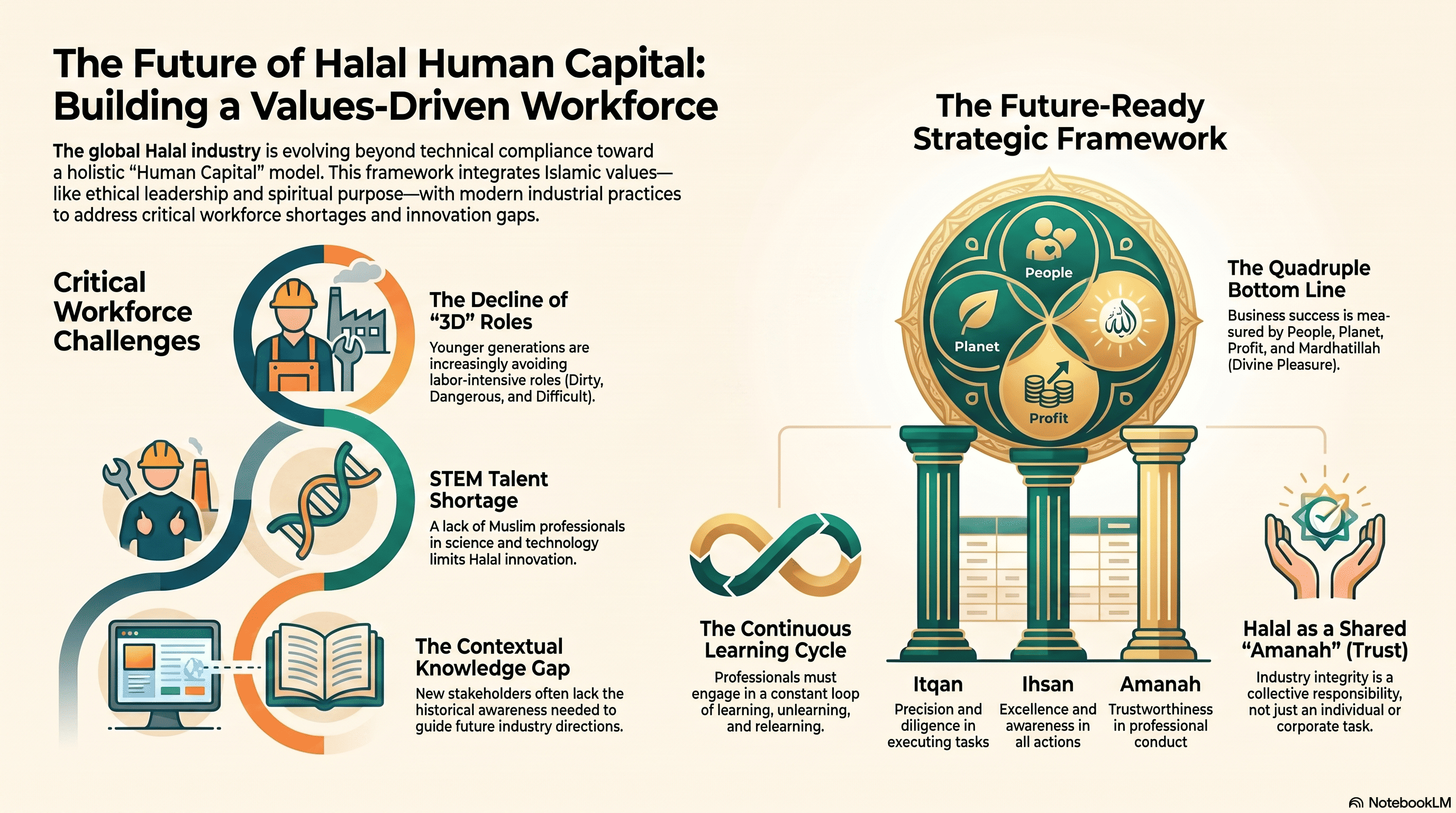
This study explores the development of Halal human capital through ethical leadership, continuous learning, and strategic collaboration. It highlights key challenges such as workforce shortages, limited interdisciplinary expertise, and the declining interest in labor-intensive roles. Emphasizing concepts such as learning, unlearning, and relearning, the study advocates integrating Islamic values with modern industry practices. The findings suggest that strengthening education, leadership, and global collaboration is essential for building a resilient, ethical, and sustainable Halal ecosystem.
Downloads
References
Aheleroff, S., Huang, H., Xu, X., & Zhong, R. Y. (2022). Toward sustainability and resilience with Industry 4.0 and Industry 5.0. Frontiers in Manufacturing Technology, 2. https://doi.org/10.3389/fmtec.2022.951643
Aloulou, M., Grati, R., Al-Qudah, A. A., & Al-Okaily, M. (2023). Does FinTech adoption increase the diffusion rate of digital financial inclusion? A study of the banking industry sector. Journal of Financial Reporting & Accounting, 22(2), 289–307. https://doi.org/10.1108/JFRA-05-2023-0224
Amnas, M. B., Selvam, M., & Parayitam, S. (2024). FinTech and financial inclusion: Exploring the mediating role of digital financial literacy and the moderating influence of perceived regulatory support. Journal of Risk and Financial Management, 17(3), 108. https://doi.org/10.3390/jrfm17030108
Arslan, A., Gölgeci, İ., Khan, Z., Al-Tabbaa, O., & Hurmelinna-Laukkanen, P. (2020). Adaptive learning in cross-sector collaboration during global emergency: Conceptual insights in the context of COVID-19 pandemic. Multinational Business Review, 29(1), 21–42. https://doi.org/10.1108/MBR-07-2020-0153
Asutay, M., & Ubaidillah, U. (2023). Examining the impact of intellectual capital performance on financial performance in Islamic banks. Journal of the Knowledge Economy, 15(1), 1231–1263. https://doi.org/10.1007/s13132-023-01114-1
Azam, M. S. E., & Abdullah, M. A. (2020). Global halal industry: Realities and opportunities. International Journal of Islamic Business Ethics, 5(1), 47–59. https://doi.org/10.30659/ijibe.5.1.47-59
Dashti, L. A. H. F., Jackson, T., West, A., & Jackson, L. (2024). Enhancing halal food traceability: A model for rebuilding trust and integrity in Muslim countries. Journal of Islamic Marketing, 15(12), 3382–3408. https://doi.org/10.1108/JIMA-06-2023-0167
Hidayat, S. E., Rafiki, A., & Nasution, M. D. T. P. (2021). Halal industry’s response to a current and post-COVID-19 landscape and lessons from the past. Journal of Islamic Marketing, 13(9), 1843–1857. https://doi.org/10.1108/JIMA-06-2020-0180
Islam, M. M., Talib, M. S. A., & Muhamad, N. (2023). Challenges of halal standards and halal certification for Islamic marketing. Muslim Business and Economic Review, 2(1), 105–124. https://doi.org/10.56529/mber.v2i1.156
Meylinda, S., & Matondang, R. A. (2023). Strengthening of Islamic principles in the halal industry for sustainable development goals. Islamic Economics Methodology, 2(1). https://doi.org/10.58968/iem.v2i1.187
Salaheldeen, M., Battour, M., Nazri, M. A., & Bustamam, U. S. A. (2021). Prospects for achieving the Sustainable Development Goals 2030 through a proposed halal entrepreneurship success index (HESI). SHS Web of Conferences, 124, 08001. https://doi.org/10.1051/shsconf/202112408001
Downloads
Published
How to Cite
Issue
Section
License
Copyright (c) 2025 Roziatul Akmam Osman

This work is licensed under a Creative Commons Attribution-NonCommercial-ShareAlike 4.0 International License.