Continuous Improvement in the Halal Industry: Lessons From Islamic History
DOI:
https://doi.org/10.55265/halalreviews.v5i1.145Keywords:
Halal Industry, Ethical Leadership, Continuous Improvement, Islamic Ethics, Halal GovernanceAbstract
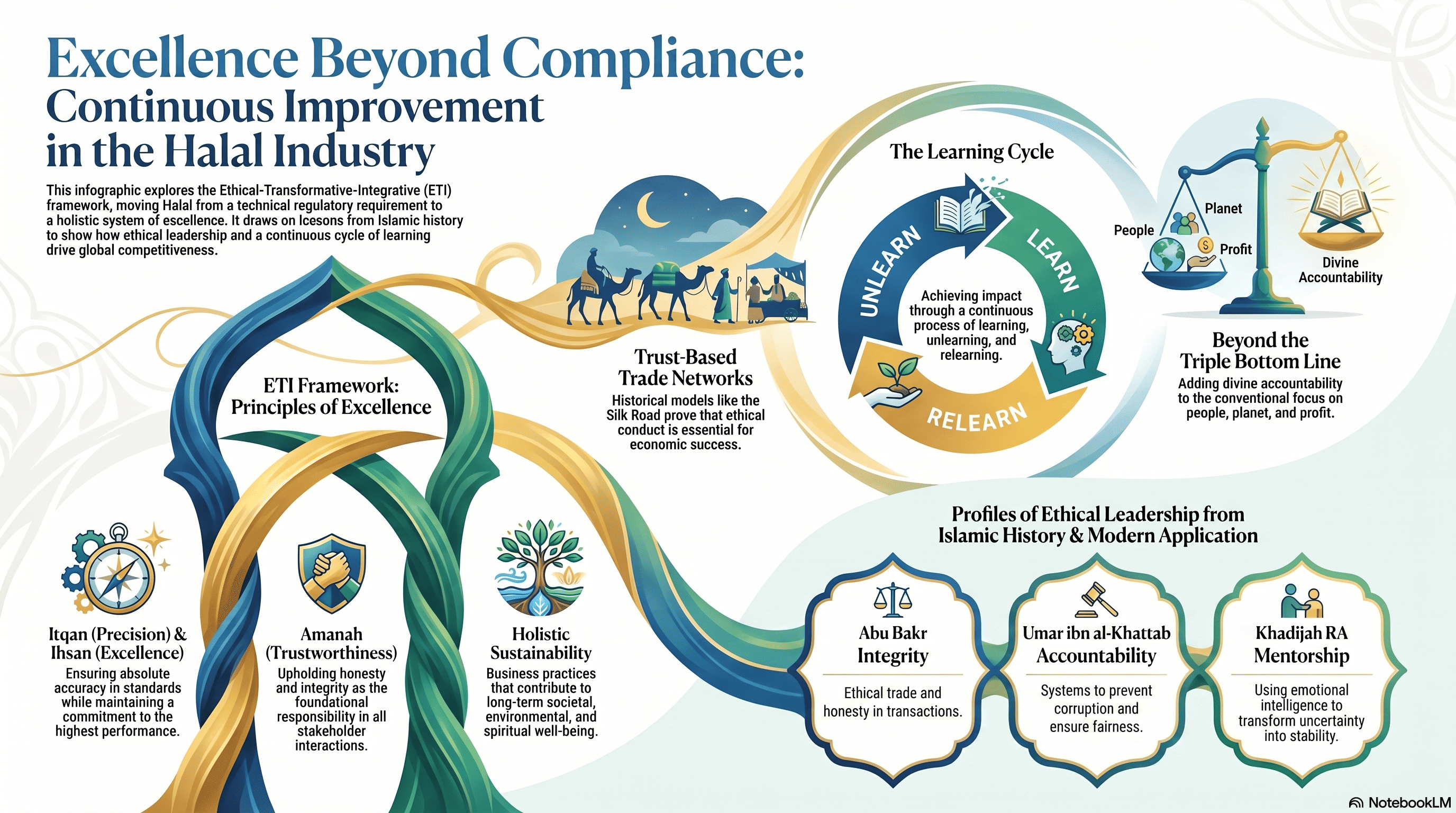
This study examines the role of ethical leadership and continuous improvement in advancing the Halal industry, drawing on principles derived from Islamic teachings, historical practices, and contemporary industry challenges. Moving beyond a purely technical understanding of Halal as regulatory compliance, the paper conceptualizes Halal as a holistic framework integrating ethics, spirituality, governance, and operational excellence. It introduces the Ethical-Transformative-Integrative (ETI) framework, encompassing core principles such as itqan (precision), ihsan (excellence), amanah (trustworthiness), mutual respect, and sustainability, as a foundation for ethical leadership in the Halal ecosystem. Through an analysis of historical models, including trade practices along the Silk Road and governance systems in early Islamic societies, the study demonstrates how ethical values have historically underpinned economic success and social trust. The paper further explores contemporary challenges, including balancing profitability with ethical obligations, fragmentation of standards, and the need for interdisciplinary knowledge integration. Emphasis is placed on the processes of learning, unlearning, and relearning as mechanisms for continuous improvement and adaptation in a rapidly evolving global environment. The findings suggest that sustainable growth in the Halal industry requires the integration of ethical leadership, collaborative governance, and innovation-driven practices. The study concludes that embedding Islamic ethical principles within modern industry systems can enhance integrity, strengthen consumer trust, and position the Halal industry as a globally competitive and morally grounded economic sector.
Downloads
References
Agustian, K., Hejazziey, D., Zen, A., Sekarini, R. A., & Wiwin, W. (2023). Comparative analysis of ethical and legal principles in the Islamic business management model. Journal of Contemporary Administration and Management (ADMAN), 1(2), 101–107. https://doi.org/10.61100/adman.v1i2.52
Akpan, J. U., & Oluwagbade, O. I. (2024). Social and environmental responsibility in accounting: Beyond financial metrics. International Journal of Social Sciences and Management Research, 9(9), 163–188. https://doi.org/10.56201/ijssmr.v9.no9.2023.pg163.188
Alrubaishi, D., McAdam, M., & Harrison, R. (2021). Culture, convention, and continuity: Islam and family firm ethical behavior. Business Ethics, the Environment & Responsibility, 30(2), 202–215. https://doi.org/10.1111/beer.12328
Anwar, U. A. A., Nurhakim, H. Q., Hamidah, K., Azzahra, S. F., & Arkani, Z. H. (2024). MSMEs awareness in halal certification from an operations management perspective. Amwaluna: Jurnal Ekonomi dan Keuangan Syariah, 8(1), 66–75. https://doi.org/10.29313/amwaluna.v8i1.2977
Azam, M. S. E., & Abdullah, M. A. (2020). Global halal industry: Realities and opportunities. International Journal of Islamic Business Ethics, 5(1), 47–59. https://doi.org/10.30659/ijibe.5.1.47-59
Bek-Gaik, B., & Surowiec, A. (2023). Sustainable business models in non-financial reporting in Polish practice. European Research Studies Journal, 26(4), 973–995. https://doi.org/10.35808/ersj/3868
Bux, C., Varese, E., Amicarelli, V., & Lombardi, M. (2022). Halal food sustainability between certification and blockchain: A review. Sustainability, 14(4), Article 2152. https://doi.org/10.3390/su14042152
Cahya, M., Ahmad, M., Hassan, R., Alam, S., Sayuti, N., Alserhan, B., Azam, A., Mohsin, M., Farrukh, M., Bonne, K., Verbeke, W., Daud, S., Mohamed, R., Al-Tabbaa, O., El-Gohary, H., Fischer, J., Fisher, J., Ajzen, I., Goitein, S., … Grant, J. (2024). Islamic civilization and history. Qishoh, 1(1). https://doi.org/10.59784/qishoh.v1i1
Daghistani, S. A. (2023). Beyond Maṣlaḥah. American Journal of Islam and Society, 39(3-4), 57–86. https://doi.org/10.35632/ajis.v39i3-4.2988
Gorski, A.-T., & Dumitrașcu, D. D. (2023). Stakeholder ecosystems and corporate sustainability: A nexus for value creation in the age of sustainability. Studies in Business and Economics, 18(2), 158–177. https://doi.org/10.2478/sbe-2023-0030
Handayati, P., Rochayatun, S., & Meldona. (2024). Halal food certification and sustainability performance: A conceptual paper. KnE Social Sciences. https://doi.org/10.18502/kss.v9i4.15064
Ibrahim, A. R., & Abdulrauph, M. (2023). Public sector fraud control in the caliphate of Umar ibn Abdul-Aziz. In Advances in Finance, Accounting, and Economics Book Series (pp. 266–282). IGI Global. https://doi.org/10.4018/979-8-3693-1190-5.ch014
Ibrahim, A. S., & Tijjani, T. S. (2024). The ethical compass of Islamic corporate social responsibility: A path to sustainable impact. In IntechOpen eBooks. IntechOpen. https://doi.org/10.5772/intechopen.1005405
Judijanto, L., Mokodenseho, S., Birah, I. F., Mamonto, A., & Mokodongan, G. L. (2024). The role of sharia risk management, Islamic investment ethics, and riba-free financing in the development of the halal industry in Indonesia. Jurnal Multidisiplin West Science, 3(3), 366–377. https://doi.org/10.58812/jmws.v3i03.1061
Karudin, K. M., Shaharudin, M. R., Zainoddin, A. I., & Moryadee, C. (2024). Halal logistics, halal manufacturing, competitiveness and halal organizational sustainability: A conceptual exploration. Information Management and Business Review, 16(3), 1001–1011. https://doi.org/10.22610/imbr.v16i3(i)s.3977
Malaysian Code on Corporate Governance. (2021). Malaysian Code on Corporate Governance. Securities Commission Malaysia.
Rahman, M. M., & Ahmad, Z. (2024). Ensuring halal product integrity and an investigative study of U.S. policy practices. Journal of World Science, 3(1), 58–68. https://doi.org/10.58344/jws.v3i1.528
Rangkuti, M. Y. (2023). Toward a holistic framework of Islamic business ethics: Insights from leadership, halal practices, and finance in a digital age. Sinergi International Journal of Islamic Studies, 1(3), 114–127. https://doi.org/10.61194/ijis.v1i3.593
Shabana, R., Siddiqui, M. M. R., & Taiba, S. (2023). Prevailing legacy of the Khulāfa-e-Rāshidīn: Their enduring influence on present age Islamic governance. Al-Qamar, 6(2), 105–118. https://doi.org/10.53762/alqamar.06.02.e08
Soumena, F. Y., Afifa, N., Amanah, I. N., & Julian, A. (2024). Business to business (B2B) model from an Islamic economic perspective. Journal of Islamic Economics and Philanthropy, 6(4), 325–343. https://doi.org/10.21111/jiep.v6i4.11624
Suryani, S., Sudrajat, B., Hendryadi, H., Saihu, M., Amalia, E., & Fathoni, M. A. (2022). Development of thriving at work and organizational citizenship behavior through Islamic work ethics and humble leadership. Asian Journal of Business Ethics, 12(1), 1–23. https://doi.org/10.1007/s13520-022-00160-3
Voak, A., Fairman, B., & Wahyuni, H. C. (2023). Halal supply chain competencies. Journal of Resilient Economies, 3(2). https://doi.org/10.25120/jre.3.2.2023.4021
Zulham, Z., Aini, Q., Mehmood, N., Sharma, S., Iswanto, A. H., Wekke, I. S., Zainal, A. G., Панова, Е., & Fedorova, N. (2022). Analysing the relationship between ethical leadership and the voice of Malaysian Muslim employees. HTS Teologiese Studies / Theological Studies, 78(4), Article 7340. https://doi.org/10.4102/hts.v78i4.7340
Zulkifli, Z., Purwati, A. A., Renaldo, N., Hamzah, Z., & Hamzah, M. L. (2023). Employee performance of Sharia bank in Indonesia: The mediation of organizational innovation and knowledge sharing. Cogent Business & Management, 10(3), Article 2273609. https://doi.org/10.1080/23311975.2023.2273609
Downloads
Published
How to Cite
Issue
Section
License
Copyright (c) 2025 Roziatul Akmam Osman

This work is licensed under a Creative Commons Attribution-NonCommercial-ShareAlike 4.0 International License.