Bridging the Gap: From Islamic Scholarship to Halal Industry Leadership
DOI:
https://doi.org/10.55265/halalreviews.v5i1.144Keywords:
Halal Industry, Halal Governance, Knowledge Integration, Shariah Compliance, Interdiscipinary EducationAbstract
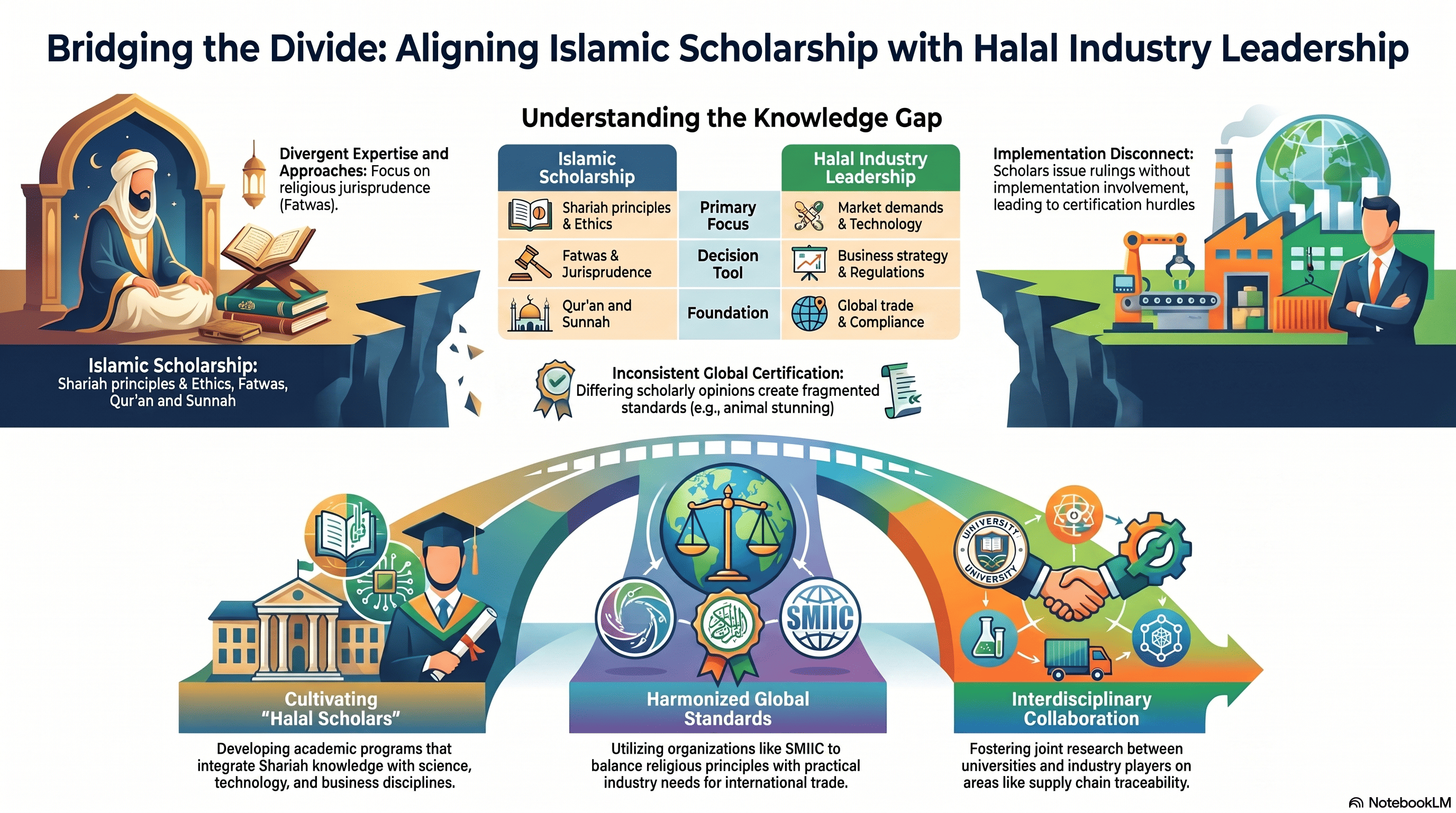
This study examines the critical gap between Islamic scholarship and Halal industry leadership, emphasizing the need for an integrated knowledge ecosystem to ensure effective governance and sustainable development of the global Halal industry. While Islamic scholars provide authoritative guidance on Shariah principles, industry practitioners operate within complex environments shaped by technological advancement, market demands, and regulatory frameworks. This divergence has resulted in challenges related to standardization, compliance, and the practical application of religious rulings. The paper analyzes the conceptual foundations of Islamic scholarship, industry practices, and leadership roles, highlighting differences in knowledge orientation, decision-making approaches, and operational priorities. It further explores key challenges arising from this gap, including inconsistencies in Halal certification, limited interdisciplinary collaboration, and tensions between ethical considerations and commercial objectives. Through an examination of knowledge transfer mechanisms and collaborative initiatives, particularly within the Malaysian context, the study demonstrates the importance of integrating academic expertise with industry practices. It also emphasizes the need for scholars to engage with contemporary disciplines such as science, technology, and global trade to remain relevant in modern Halal governance. The findings suggest that bridging this gap requires the development of interdisciplinary education, collaborative research platforms, and globally harmonized standards. The study concludes that fostering a new generation of professionals equipped with both Shariah knowledge and technical expertise is essential for building a cohesive, ethical, and future-ready Halal ecosystem.
Downloads
References
Adeoye, M. A., & Baharun, H. (2025). Integration of Islamic thought and scientific knowledge in the formation of educational institution leadership. Tatho, 141–152. https://doi.org/10.70512/tatho.v2i2.85
Agustian, K., Hejazziey, D., Zen, A., Sekarini, R. A., & Wiwin, W. (2023). Comparative analysis of ethical and legal principles in the Islamic business management model. Journal of Contemporary Administration and Management (ADMAN), 1(2), 101–107. https://doi.org/10.61100/adman.v1i2.52
Ahmad, Z., Mafaz, M. N. A., & Rahman, D. M. M. (2023). Harmony in halal: Understanding stakeholder views analyzing products and evaluating policies in Malaysia. West Science Business and Management, 1(5), 495–508. https://doi.org/10.58812/wsbm.v1i05.358
Akter, F., Shakil, M. R. U., Akter, Y., Fatema, K., Afi, N. J. B., Azizan, N., & Hamid, K. A. (2024). Collaborative models for community-driven industrial education: Enhancing workforce development through partnership programs in Malaysia. Information Management and Business Review, 16, 1050–1062. https://doi.org/10.22610/imbr.v16i3(i)s.4159
Ali, N. M. B., Kamaruddin, K., Salleh, S. M., Hamzah, S. F. M., Harahap, A. Z. M. K., B, L. S., Setia, R., Mokhlas, H., & Borhanuddin, R. I. (2026). Developing Islamic ethical institutionalization capability in halal logistics: An integrative framework for sustainable halal supply chains. International Journal of Academic Research in Business and Social Sciences, 16(3). https://doi.org/10.6007/IJARBSS/v16-i3/27525
Alwi, Z. (2020). Halal analysis principle for food and pharmaceutical: A case study of gelatin. https://doi.org/10.4108/eai.1-10-2019.2291692
Annaprimadonita. (2024). Methodological transformations in contemporary Islamic studies: Trends, challenges, and future directions. Sinergi International Journal of Islamic Studies, 2(3), 190–202. https://doi.org/10.61194/ijis.v2i3.610
Asmara, A., & Wu, M. (2020). An analytical study on the effective approaches to facilitate higher education cooperate with industry: Based on faculty members perspective. TEM Journal, 1721–1731. https://doi.org/10.18421/tem94-53
Azmar, Z., & Aghwan, Z. A. (2025). Divergent strategies for halal meat production: A comparison of halal slaughtering practices in Muslim and non-Muslim countries. Journal of Halal Science and Management Research, 1(1), 248–263. https://doi.org/10.24191/jhsmr.v1i1.9000
Cholid, M. I. (2025). The Sharia foundation in Islamic microeconomics: An analysis of the concepts of tawhid, naqli evidence, and maqasid al-shariah. In Zenodo. European Organization for Nuclear Research. https://doi.org/10.5281/zenodo.17654730
Esangbedo, C. O., Zhang, J., Esangbedo, M. O., Kone, S. D., & Xu, L. (2023). The role of industry-academia collaboration in enhancing educational opportunities and outcomes under the digital driven Industry 4.0. Journal of Infrastructure Policy and Development, 8(1). https://doi.org/10.24294/jipd.v8i1.2569
Esmail, A. H. M. S., & Khan, Z. M. (2024). Alignment of vocational education curricula with job requirements in industrial sector: Analysis study. World Journal of Advanced Research and Reviews, 21(3), 2303–2313. https://doi.org/10.30574/wjarr.2024.21.3.1002
Fitriani, F., Wahab, A., & Hendratmi, A. (2025). Leadership in halal business sector: Bibliometric analysis and a roadmap for future research. Journal of Leadership in Organizations, 7(2), 138. https://doi.org/10.22146/jlo.103552
Herdiana, Y., Sofian, F. F., Shamsuddin, S., & Rusdiana, T. (2023). Towards halal pharmaceutical: Exploring alternatives to animal-based ingredients. Heliyon, 10(1). https://doi.org/10.1016/j.heliyon.2023.e23624
Husna, A., Wong, M. S. M. A., & Osman, A. S. (2022). The enforcement of halal compliance by authorities in the halal industry. Environment-Behaviour Proceedings Journal, 7, 543–548. https://doi.org/10.21834/ebpj.v7isi7.3829
Hussain, M. (2025). Strengthening global halal supply chains through Shariah-compliant governance and digital traceability: Challenges and strategic opportunities in a globalized economy. Journal of Islamic Finance and Economic Studies, 1(2), 89–99. https://doi.org/10.64268/jifes.v1i2.64
Karbhari, Y., Benamraoui, A., & Hassan, A. F. S. (2023). Sharia boards, managerial strategies and governance practices in Islamic banks: A Goffmanesque discourse. Accounting, Auditing & Accountability Journal, 37(4), 1069–1095. https://doi.org/10.1108/AAAJ-07-2017-3037
Kusuma, R. A. (2023). Bibliometric analysis of food and post-harvest research in enhancing the integrity of halal food industry. Agroindustrial Technology Journal, 7(2). https://doi.org/10.21111/atj.v7i2.9409
Lahuri, S. bin, Pranoto, M. R., Kamaluddin, I., Syamsuri, S., Cahyo, E. N., & Yusuf, M. (2025). Halal certification governance in Indonesia: An Islamic legal appraisal based on maṣlaḥah principles. JURIS (Jurnal Ilmiah Syariah), 24(2), 233–247. https://doi.org/10.31958/juris.v24i2.15411
Munandar, A. N. I., Ratnasari, R. T., Rusgianto, S., & Permana, I. D. G. D. (2026). Faith at work: How Islamic leadership transforms Indonesia’s Islamic banking landscape. Journal of Islamic Accounting and Business Research, 1–19. https://doi.org/10.1108/JIABR-03-2025-0172
Muzamiru, N., Ismael, & Tawfik, A. (2024). Halal certification: Legal and ethical consideration in Islamic jurisprudence. Universiti Utara Malaysia Institutional Repository.
Nader, V. (2025). Islamic finance’s ideals vs. reality: Unpacking ethics, governance, and practice. E-Space (Manchester Metropolitan University). https://e-space.mmu.ac.uk/view/authors/65e912ef54cb09cda6d89ecacfbb7bac.html
Nafis, M. D., & Khusnudin. (2026). Interdisciplinary Islamic studies: Reconstructing sciences for maqāṣid-based Islamic economics in digital finance. Jurnal Ilmiah Akuntansi Kesatuan, 14(1), 1–14. https://doi.org/10.37641/jiakes.v14i1.4925
Priyadi, U. (2023). Institutional economics lens: A comprehensive review on the interdisciplinary integration between Islamic studies and economics. Kaav International Journal of Economics Commerce & Business Management. https://doi.org/10.52458/23484969.2023.v10.iss4.kp.a6
Putra, A. H. P. K., Mansur, D. M., Ulfah, M., Nurmiati, & Hajiali, I. (2023). Key factors of business sustainability: Strengthening leadership, psychology, and fairness aspects from an Islamic-management perspective. NURTURE, 17(4), 694–710. https://doi.org/10.55951/nurture.v17i4.500
Rahman, M. M., Razimi, M. S. A., Ariffin, A. S., & Hashim, N. (2024). Navigating moral landscape: Islamic ethical choices and sustainability in halal meat production and consumption. Discover Sustainability, 5(1). https://doi.org/10.1007/s43621-024-00388-y
Rangkuti, M. Y. (2023). Toward a holistic framework of Islamic business ethics: Insights from leadership, halal practices, and finance in a digital age. Sinergi International Journal of Islamic Studies, 1(3), 114–127. https://doi.org/10.61194/ijis.v1i3.593
Risza, H. (2024). The role of universities in pioneering halal product innovation and education in Indonesia. AL-ISHLAH Jurnal Pendidikan, 16(2), 821–829. https://doi.org/10.35445/alishlah.v16i2.5218
Riyadi, S., & Rozaanah, R. (2025). Mapping the halal industry: A decade of bibliometric trends and strategic implications for Islamic economics education in Indonesia. RAFAHIYA Journal of Islamic Economics, 1(1), 9–14. https://doi.org/10.37010/rafahiya.v1i1.19
Sahhari, A. S. A., Azmi, L. K., Razi, R. F., Mukti, K. W., & Hidayatullah, I. (2025). Balancing regulatory efficiency and halal integrity: A governance analysis of Indonesia’s self-declaration system in halal certification. JURNAL INDO-ISLAMIKA, 15(1), 153–172. https://doi.org/10.15408/jii.v15i1.47339
Salam, S. A. (2023). Roles of Islamic Shariah scholars in the halal assurance system. Journal of Halal Science and Technology, 2(1), 40–47. https://doi.org/10.59202/jhst.v2i1.666
Sari, Y. I., & Cokrohadisumarto, W. bin M. (2019). Modeling sustainability model of Islamic microfinance institutions. Journal of Islamic Monetary Economics and Finance, 5(4), 713–740. https://doi.org/10.21098/jimf.v5i4.1127
Sarı, M., & Prayoga, F. (2025). Critical perspectives on maqashid al-shariah in modern financial systems. GIC Proceeding, 3, 73–81. https://doi.org/10.30983/gic.v3i1.847
Sati, A., Halim, A., Nasution, A., & Ridwan, M. (2025). The digital transformation of tafsir and its implications for Islamic legal derivation in the contemporary era. MILRev Metro Islamic Law Review, 4(1), 389–415. https://doi.org/10.32332/milrev.v4i1.10425
Urus, N. S. T., Azzis, N. M. Abd., Roslan, E. S., & Affendi, S. N. Y. S. N. (2025). Global recognition of halal certification: A fundamental, innovative, and international paradigm for ensuring integrity and enhancing competitiveness in the global halal industry. International Journal of Academic Research in Business and Social Sciences, 15(9). https://doi.org/10.6007/IJARBSS/v15-i9/26470
Voak, A., Fairman, B., & Helmy, A. (2024). Building sustainable futures: Developing a halal supply chain leadership competency framework. El-Jizya Jurnal Ekonomi Islam, 12(1), 1–16. https://doi.org/10.24090/ej.v12i1.10935
Yuanitasari, D., Harrieti, N., & Salaeh, Y. (2025). Harmonizing Sharia-based halal standards with international trade law: A comparative legal study. Lampung Journal of International Law, 7(1), 47–62. https://doi.org/10.25041/lajil.v7i1.4468
Downloads
Published
How to Cite
Issue
Section
License
Copyright (c) 2025 Fadhli Rahman Abas

This work is licensed under a Creative Commons Attribution-NonCommercial-ShareAlike 4.0 International License.