Global Differences in Halal Certification Standards
DOI:
https://doi.org/10.55265/halalreviews.v5i1.141Keywords:
Halal Certification, Standardization, Halal Governance, Global Halal Industry, Certification ModelsAbstract
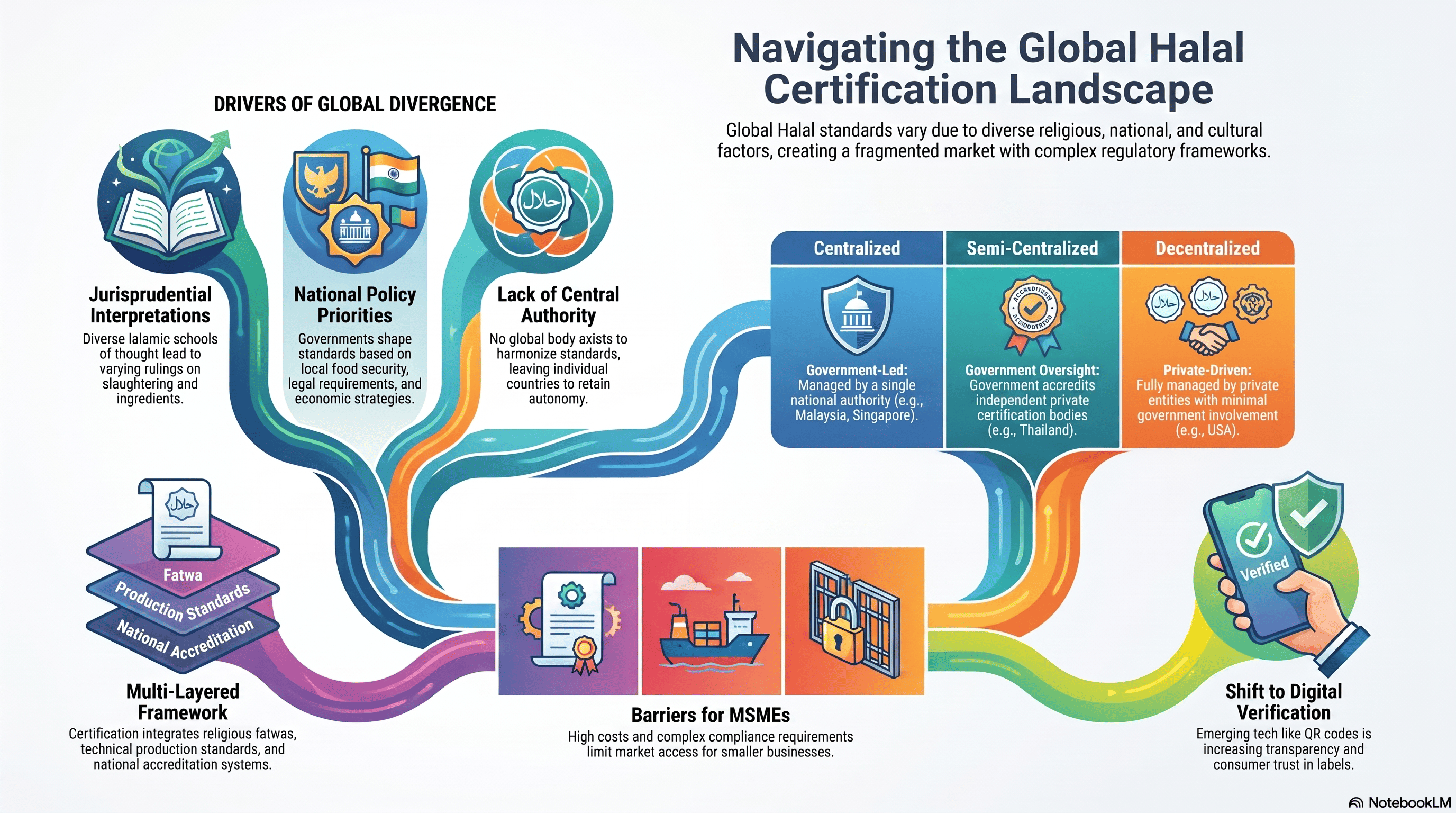
This study examines the diversity of Halal certification standards across the global Halal industry, focusing on the underlying factors, governance models, and strategic implications for stakeholders. As the demand for Halal products continues to expand internationally, the absence of a unified global standard has resulted in fragmented certification systems characterized by multiple logos, varying compliance requirements, and inconsistent regulatory frameworks. The paper analyzes key factors contributing to these differences, including variations in Islamic jurisprudential interpretations, national regulatory priorities, cultural influences, and the lack of a centralized global Halal authority. It further categorizes existing certification systems into centralized, semi-centralized, decentralized, and hybrid models, highlighting their respective strengths and limitations in ensuring consistency and flexibility. In addition, the study explores the multi-layered structure of Halal standards, encompassing fatwa-based rulings, technical standards, certification policies, and accreditation systems. While significant convergence exists on fundamental Halal principles, notable differences persist in areas such as slaughtering practices, facility requirements, and labeling standards. The findings indicate that these variations pose considerable challenges for businesses—particularly micro, small, and medium enterprises (MSMEs)—in terms of cost, compliance complexity, and market access. Emerging trends, including the use of digital verification tools and increased consumer awareness, suggest potential pathways toward enhanced transparency and trust. The study concludes that while full harmonization remains a long-term objective, strategic collaboration, mutual recognition efforts, and technological integration are essential for navigating the fragmented landscape and strengthening the global Halal ecosystem.
Downloads
References
Abdallah, A. E., Rahem, M. A., & Pasqualone, A. (2021). The multiplicity of halal standards: A case study of application to slaughterhouses. Journal of Ethnic Foods, 8(1), Article 8. https://doi.org/10.1186/s42779-021-00084-6
Abidin, N. Z., & Perdana, F. F. P. (2020). A proposed conceptual framework for blockchain technology in halal food product verification. Journal of Halal Industry & Services, 3, Article a0000079. https://doi.org/10.36877/jhis.a0000079
Akbar, J., Gul, M., Jahangir, M., Adnan, M., Saud, S., Hassan, S., Nawaz, T., & Fahad, S. (2023). Global trends in halal food standards: A review. Foods, 12(23), Article 4200. https://doi.org/10.3390/foods12234200
Al-Mahmood, O. A., & Fraser, A. (2023). Perceived challenges in implementing halal standards by halal certifying bodies in the United States. PLoS ONE, 18(8), Article e0290774. https://doi.org/10.1371/journal.pone.0290774
Asioli, D., Fuentes-Pila, J., Alarcón, S., Jia, H., Liu, J., Hocquette, J.-F. J.-F., & Nayga, R. M. (2022). Consumers’ valuation of cultured beef burger: A multi-country investigation using choice experiments. Food Policy, 112, Article 102376. https://doi.org/10.1016/j.foodpol.2022.102376
Azam, M. S. E., & Abdullah, M. A. (2020). Global halal industry: Realities and opportunities. International Journal of Islamic Business Ethics, 5(1), 47–59. https://doi.org/10.30659/ijibe.5.1.47-59
Fadhillah, A. A., & Saputra, R. P. (2025). Systematic review: Comparison of halal regulations in Asia. Journal of Halal Science and Research, 6(2), 134–146. https://doi.org/10.12928/jhsr.v6i2.12111
Hamzah, S. A. S., Johari, S., Yusof, Y. A., Ramlan, M. A., & Azmi, P. U. B. M. (2024). A structured review: Halal regulatory system. Journal of Tourism, Hospitality and Environment Management, 9(38), 259–289. https://doi.org/10.35631/jthem.938018
Hu, W., & Jiang, J. (2025). Professionalization trajectory of healthcare interpreter certification in the context of the language industry: A comparative study of industry-led and government-led models, with implications for China. Frontiers in Public Health, 13, Article 1650602. https://doi.org/10.3389/fpubh.2025.1650602
Johan, E., & Casado, M. J. P. (2023). Harmonizing halal in ASEAN: Analysis of halal food guidelines under the ASEAN way approach. JAS (Journal of ASEAN Studies), 11(1), 43–67. https://doi.org/10.21512/jas.v11i1.9682
Judijanto, L. (2025). Governance issues in sustainability certification: A review of implementation challenges and complexities. International Journal of Applied Research and Sustainable Sciences, 3(8), 701–718. https://doi.org/10.59890/ijarss.v3i8.99
Letti, L. A. J., Karp, S. G., Molento, C. F. M., Colonia, B. S. O., Boschero, R. A., Thomaz‐Soccol, V., Herrmann, L. W., Penha, R. de O., Woiciechowski, A. L., & Soccol, C. R. (2021). Cultivated meat: Recent technological developments, current market and future challenges. Biotechnology Research and Innovation, 5(1), Article e202101. https://doi.org/10.4322/biori.202101
Matus, K., & Veale, M. (2021). Certification systems for machine learning: Lessons from sustainability. Regulation & Governance, 16(1), 177–196. https://doi.org/10.1111/rego.12417
Munawar, M., & Mugiono, A. (2024). Framework for smart contract blockchain in halal traceability, integrity, and transparency. International Journal of Electrical and Computer Engineering, 14(3), 2875–2884. https://doi.org/10.11591/ijece.v14i3.pp2875-2884
Noordin, N., Noor, N. L. M., & Samicho, Z. (2014). Strategic approach to halal certification system: An ecosystem perspective. Procedia - Social and Behavioral Sciences, 121, 79–95. https://doi.org/10.1016/j.sbspro.2014.01.1110
Othman, H., & Ibrahim, I. (2025). Halal certification by globalization: Packaging variance, enhancing efficiency and lowering compliance barriers. International Journal of Research and Innovation in Social Science, 9(1), 110–125. https://doi.org/10.47191/ijriss.2025.914mg009
Putri, N. T., Kharisman, A., Arief, I., Talib, H. H. A., Jamaludin, K. R., & Ismail, E. A. (2022). Designing food safety management and halal assurance systems in mozzarella cheese production for small-medium food industry. Indonesian Journal of Halal Research, 4(2), 65–84. https://doi.org/10.15575/ijhar.v4i2.12996
Rohmah, S. (2020). Authoritarianism in the Halal Product Guarantee Act of Indonesia: A contribution to an ongoing debate. Indonesia Law Review, 10(3), Article 3. https://doi.org/10.15742/ilrev.v10n3.645
Rubio, N. R., Xiang, N., & Kaplan, D. L. (2020). Plant-based and cell-based approaches to meat production. Nature Communications, 11(1), Article 6276. https://doi.org/10.1038/s41467-020-20061-y
Selvakumar, P., Dahiya, R., Malik, N., Manjunath, T. C., Sharma, M., & Kumar, R. (2025). Halal cosmetics and pharmaceutics. In IGI Global eBooks (pp. 189–210). IGI Global. https://doi.org/10.4018/979-8-3693-8618-7.ch009
Sorna, U. S., Firdaus, R. B. R., & Sarjiyanto, S. (2024). Challenges and ways forward for the Malaysian SMEs in the halal food industry: A systematic review. Potravinarstvo Slovak Journal of Food Sciences, 18, 223–238. https://doi.org/10.5219/1937
Stupak, I., Mansoor, M., & Smith, C. T. (2021). Conceptual framework for increasing legitimacy and trust of sustainability governance. Energy, Sustainability and Society, 11(1), Article 5. https://doi.org/10.1186/s13705-021-00280-x
Trager, R., Harack, B., Reuel, A., Carnegie, A., Heim, L., Ho, L. L., Kreps, S., Lall, R., Larter, O., hÉigeartaigh, S. Ó., Staffell, S., & Villalobos, J. J. (2023). International governance of civilian AI: A jurisdictional certification approach. SSRN. https://doi.org/10.2139/ssrn.4579899
Urus, N. S. T., Azzis, N. M. A., Roslan, E. S., & Affendi, S. N. Y. S. N. (2025). Global recognition of halal certification: A fundamental, innovative, and international paradigm for ensuring integrity and enhancing competitiveness in the global halal industry. International Journal of Academic Research in Business and Social Sciences, 15(9). https://doi.org/10.6007/ijarbss/v15-i9/26470
Yener, D. (2022). The effects of halal certification and product features on consumer behavior. International Journal of Management Studies, 29(2), 29–54. https://doi.org/10.32890/ijms2022.29.2.5
Yu, H., Ceross, A., & Bergmann, J. (2024). More than red tape: Exploring complexity in medical device regulatory affairs. Frontiers in Medicine, 11, Article 1415319. https://doi.org/10.3389/fmed.2024.1415319
Yuanitasari, D., Harrieti, N., & Salaeh, Y. (2025). Harmonizing Sharia-based halal standards with international trade law: A comparative legal study. Lampung Journal of International Law, 7(1), 47–62. https://doi.org/10.25041/lajil.v7i1.4468
Yustianingsih, L., Mufid, A., Maifiah, M. H. M., & Gunawan, S. (2024). Comparison study of halal management system in Indonesia and Malaysia. Halal Research Journal, 4(1), 39–55. https://doi.org/10.12928/hrj.v4i1.1027
Zhang, B.-Z., Moon, J.-W., & Park, J.-M. (2026). Comparative review of halal certification frameworks for poultry meat in Malaysia, Singapore, and Indonesia. Foods, 15(4), Article 659. https://doi.org/10.3390/foods15040659
Downloads
Published
How to Cite
Issue
Section
License
Copyright (c) 2025 Dewi Suratty

This work is licensed under a Creative Commons Attribution-NonCommercial-ShareAlike 4.0 International License.