The Role of Skilled Labor in Ensuring Halal Integrity in Animal Science and Farming
DOI:
https://doi.org/10.55265/halalreviews.v5i1.137Keywords:
Halal Integrity, Animal Farming, Skilled Labour, Animal Welfare, Halalan ToyyibanAbstract
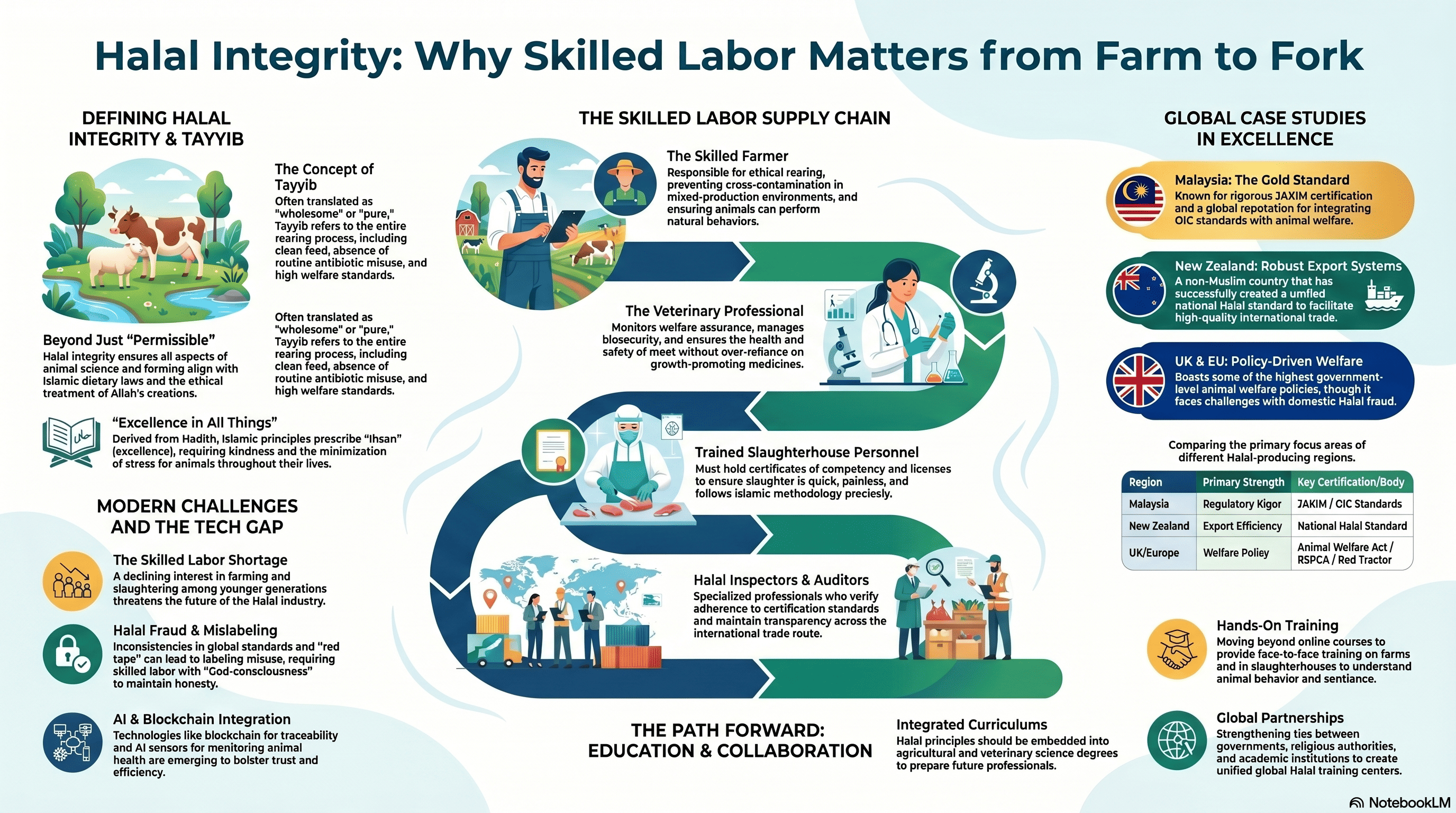
This study examines the role of skilled labour in ensuring Halal integrity across animal farming and the broader supply chain. It emphasizes the importance of pre-slaughter stages—such as animal welfare, husbandry, and farm management—within the framework of halalan tayyiban, which integrates ethical treatment, quality, and sustainability. The study highlights the need for interdisciplinary knowledge among stakeholders and identifies key challenges, including labour shortages, regulatory inconsistencies, and fraud. It also explores the role of technologies such as AI and blockchain in enhancing traceability and compliance. The findings underscore that strengthening training, integrating Halal education, and fostering collaboration are essential for a resilient and trustworthy Halal supply chain.
Downloads
References
Islam, M. M., Talib, M. S. A., & Muhamad, N. (2023). Challenges of halal standards and halal certification for Islamic marketing. Muslim Business and Economic Review, 2(1), 105–124. https://doi.org/10.56529/mber.v2i1.156
Jaber, D., Hasan, H. E., Alkaderi, A., Alkilani, A. Z., & El-Sharif, A.-R. (2024). Assessment of the knowledge, attitude, and perception of healthcare providers regarding halal pharmaceuticals. The Open Public Health Journal, 17(1). https://doi.org/10.2174/0118749445296459240322064212
Jelan, Z. A., Pratiwi, A. Y., & Isnaeni, P. D. (2024). Halal meat production in the modern era: Concepts and applications. In CRC Press eBooks (pp. 1–6). Informa. https://doi.org/10.1201/9781003468943-1
Mokti, H. A., Kamri, N. ʿAzzah, & Balwi, M. A. W. F. M. (2023). Tayyiban in halal food production: A systematic literature review. Journal of Islamic Marketing, 15(2), 397–417. https://doi.org/10.1108/JIMA-03-2022-0098
Rahman, M. M., & Ahmad, Z. (2024). Ensuring halal product integrity and an investigative study of U.S policy practices. Journal of World Science, 3(1), 58–68. https://doi.org/10.58344/jws.v3i1.528
Rahman, M. M., Razimi, M. S. A., Ariffin, A. S., & Hashim, N. (2024). Navigating moral landscape: Islamic ethical choices and sustainability in halal meat production and consumption. Discover Sustainability, 5(1). https://doi.org/10.1007/s43621-024-00388-y
Safitri, L., Syamsi, A. N., Purwaningsih, H., Muatip, K., Fadloli, A., Ariyani, D., & Rahman, I. K. (2022). Animal welfare from Islamic perspective. KnE Life Sciences. https://doi.org/10.18502/kls.v0i0.11841
Voak, A., & Fairman, B. (2021). Building human capability to ensure halal supply chain compliance. In Routledge eBooks (pp. 1–6). Informa. https://doi.org/10.1201/9781003189282-1
Voak, A., Fairman, B., & Wahyuni, H. C. (2023). Halal supply chain competencies. Journal of Resilient Economies, 3(2). https://doi.org/10.25120/jre.3.2.2023.4021
Downloads
Published
How to Cite
Issue
Section
License
Copyright (c) 2025 Gemma Ali

This work is licensed under a Creative Commons Attribution-NonCommercial-ShareAlike 4.0 International License.