Halal Malaysia’s Journey: Golden Lessons & Strategic Shared Visions for the Future
DOI:
https://doi.org/10.55265/halalreviews.v5i1.136Keywords:
Halal Governance, Malaysia, Halalan Tayyiban, Halal Ecosystem, Halal CertificationAbstract
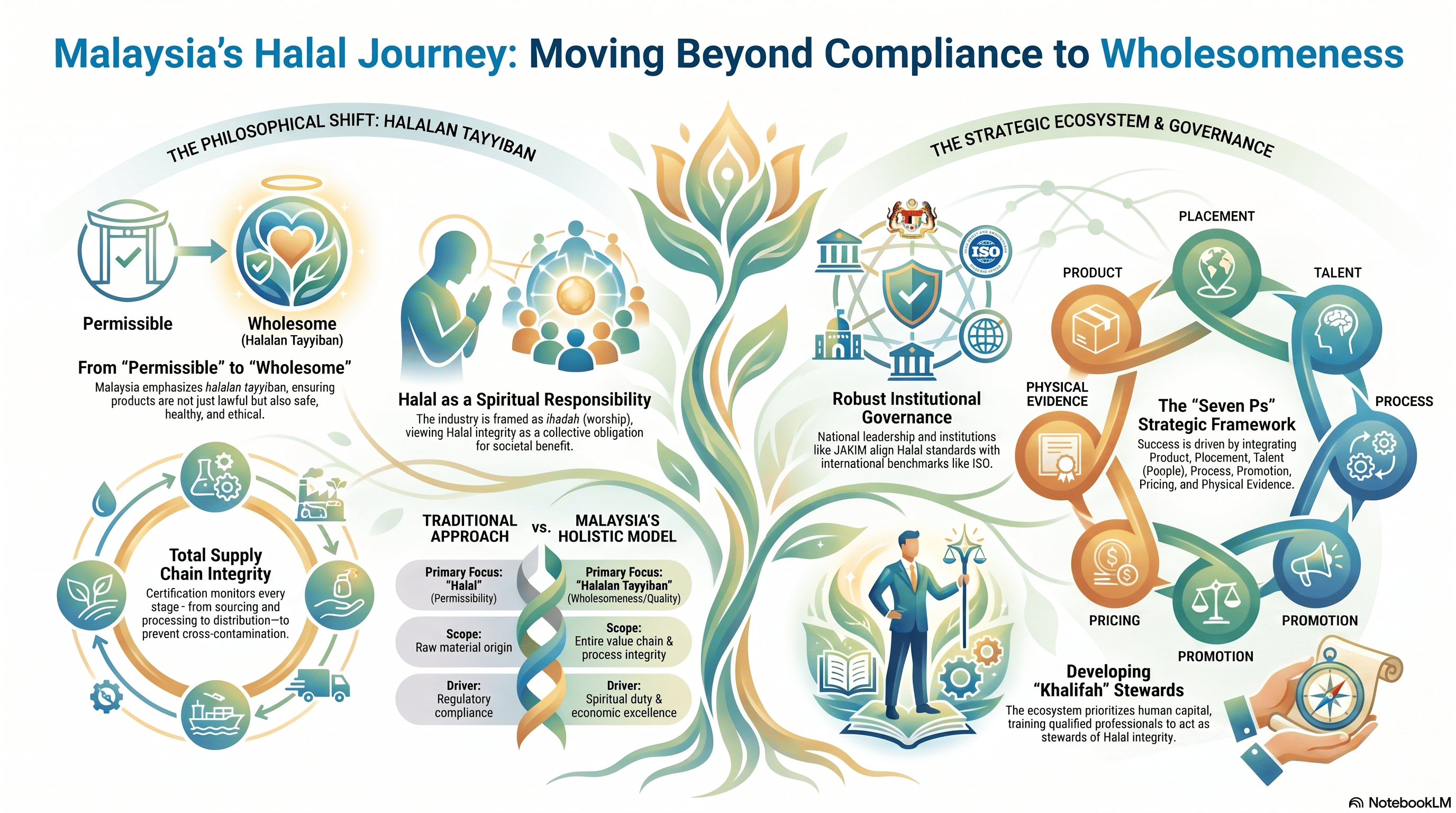
This study examines Malaysia’s Halal industry as a holistic model integrating governance, ethics, human capital, and strategic development. Framed as both an economic initiative and a spiritual responsibility, the Halal ecosystem extends beyond compliance to encompass quality, sustainability, and social accountability through the concept of halalan tayyiban. The study highlights Malaysia’s strong governance framework, institutional alignment, and strategic positioning—supported by approaches such as the “Seven Ps”—in establishing global leadership. It also emphasizes the role of knowledge integration and innovation in sustaining industry growth. Despite challenges related to global trade and socio-political dynamics, the findings underscore that continuous improvement, stakeholder collaboration, and ethical adherence are key to a resilient and competitive Halal ecosystem.
Downloads
References
Ahmad, J., Widayatmoko, W., & Taib, F. Md. (2024). Enhancing Malaysia’s halal brand identity: Insights and strategies for sustainable global halal hub. Kajian Malaysia, 42(2), 73–94. https://doi.org/10.21315/km2024.42.2.4
Ahmad, Z., Mafaz, M. N. A., & Rahman, D. M. M. (2023). Harmony in halal: Understanding stakeholder views analyzing products and evaluating policies in Malaysia. West Science Business and Management, 1(5), 495–508. https://doi.org/10.58812/wsbm.v1i05.358
Asutay, M., Aziz, P. F., Indrastomo, B. S., & Karbhari, Y. (2023). Religiosity and charitable giving on investors’ trading behaviour in the Indonesian Islamic stock market: Islamic vs market logic. Journal of Business Ethics, 188(2), 327–348. https://doi.org/10.1007/s10551-023-05324-0
Dashti, L. A. H. F., Jackson, T., West, A., & Jackson, L. (2024). Enhancing halal food traceability: A model for rebuilding trust and integrity in Muslim countries. Journal of Islamic Marketing, 15(12), 3382–3408. https://doi.org/10.1108/JIMA-06-2023-0167
Hasnan, N., & Kohda, Y. (2023). Halal supply chain: Challenges of halal certification in Japan. European Proceedings of Social & Behavioural Sciences, 132, 764–778. https://doi.org/10.15405/epsbs.2023.11.02.60
Jaaffar, A. H., Majid, N. A., Kasavan, S., Isa, A., Alwi, M. N. R., & Zahari, A. R. (2024). The effect of innovative mindset and behavior on innovation performance and competitive advantage: A case of halal SMEs owner-managers from Malaysian energy-intensive industry. Journal of Innovation and Entrepreneurship, 13(1). https://doi.org/10.1186/s13731-023-00359-z
Karudin, K. M., Shaharudin, M. R., Zainoddin, A. I., & Moryadee, C. (2024). Halal logistics, halal manufacturing, competitiveness and halal organizational sustainability: A conceptual exploration. Information Management and Business Review, 16, 1001–1011. https://doi.org/10.22610/imbr.v16i3(i)s.3977
Nugroho, A. A., Sumiyati, S., & Hamsani, H. (2024). Integrity and legitimacy of halal products: The urgency of halal supply chain management technology adoption in halal product authentication traceability evidence from Indonesia. The South East Asian Journal of Management, 18(1), 54–80. https://doi.org/10.21002/seam.v18i1.1485
Rahman, M. M., & Ahmad, Z. (2024). Lifelong learning and technologic advancement in the halal industry. In Advances in educational technologies and instructional design book series (pp. 186–216). IGI Global. https://doi.org/10.4018/979-8-3693-1410-4.ch009
Septiani, D., & Ridlwan, A. A. (2020). The effects of halal certification and halal awareness on purchase intention of halal food products in Indonesia. Indonesian Journal of Halal Research, 2(2), 55–60. https://doi.org/10.15575/ijhar.v2i2.6657
Sorna, U. S., Firdaus, R. B. R., & Sarjiyanto, S. (2024). Challenges and ways forward for the Malaysian SMEs in the halal food industry: A systematic review. Potravinarstvo Slovak Journal of Food Sciences, 18, 223–238. https://doi.org/10.5219/1937
Voak, A., Fairman, B., & Wahyuni, H. C. (2023). Halal supply chain competencies. Journal of Resilient Economies, 3(2). https://doi.org/10.25120/jre.3.2.2023.4021
Downloads
Published
How to Cite
Issue
Section
License
Copyright (c) 2025 Roziatul Akmam Osman

This work is licensed under a Creative Commons Attribution-NonCommercial-ShareAlike 4.0 International License.