Halal Education in Universities: Bridging Gaps Through Curriculum Development
DOI:
https://doi.org/10.55265/halalreviews.v5i1.153Keywords:
Halal Education, Workforce Readiness, Curriculum Development, Interdisciplinary Learning, Halal IndustryAbstract
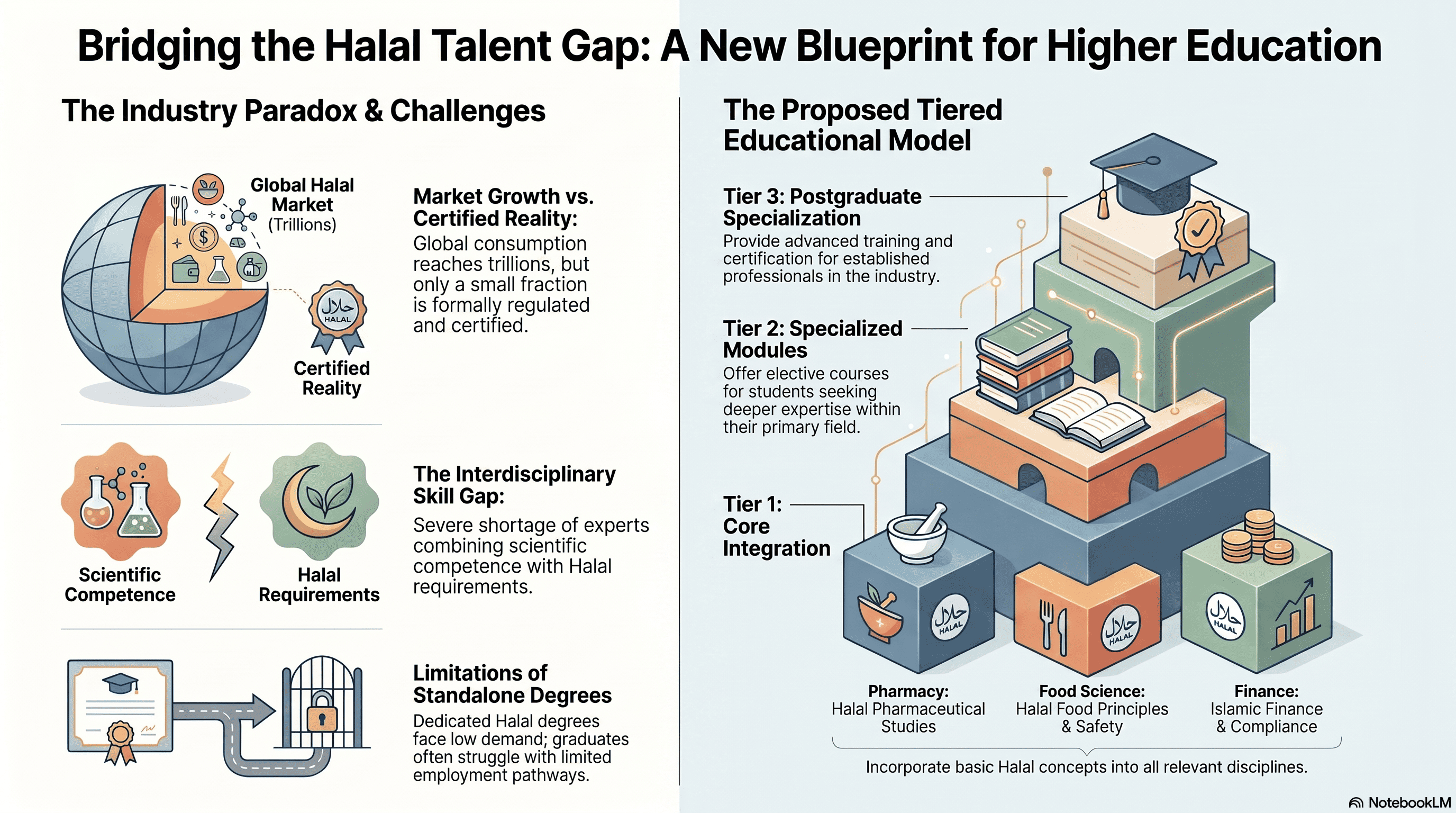
This study examines the gap between the rapid growth of the global Halal market and the limited readiness of the workforce, with a focus on the role of higher education. It highlights key challenges including low awareness, shortage of interdisciplinary experts, limited job opportunities, and weak policy prioritization. The study proposes integrating Halal knowledge into existing academic disciplines rather than establishing standalone degree programs. The findings suggest that a flexible, interdisciplinary curriculum model is essential for developing a competent workforce and supporting sustainable growth in the Halal industry.
Downloads
References
Aheleroff, S., Huang, H., Xu, X., & Zhong, R. Y. (2022). Toward sustainability and resilience with Industry 4.0 and Industry 5.0. Frontiers in Manufacturing Technology, 2. https://doi.org/10.3389/fmtec.2022.951643
Azam, M. S. E., & Abdullah, M. A. (2020). Global halal industry: Realities and opportunities. International Journal of Islamic Business Ethics, 5(1), 47–59. https://doi.org/10.30659/ijibe.5.1.47-59
Bux, C., Varese, E., Amicarelli, V., & Lombardi, M. (2022). Halal food sustainability between certification and blockchain: A review. Sustainability, 14(4), 2152. https://doi.org/10.3390/su14042152
Hidayat, Y., & Machmud, A. (2024). The existence and consistency of halal certificates in the global ecosystem of halal products and services. Amwaluna: Jurnal Ekonomi Dan Keuangan Syariah, 8(1), 102–112. https://doi.org/10.29313/amwaluna.v8i1.2975
Islam, M. M., Talib, M. S. A., & Muhamad, N. (2023). Challenges of halal standards and halal certification for Islamic marketing. Muslim Business and Economic Review, 2(1), 105–124. https://doi.org/10.56529/mber.v2i1.156
Jaber, D., Hasan, H. E., Alkaderi, A., Alkilani, A. Z., & El-Sharif, A.-R. (2024). Assessment of the knowledge, attitude, and perception of healthcare providers regarding halal pharmaceuticals. The Open Public Health Journal, 17(1). https://doi.org/10.2174/0118749445296459240322064212
Jannah, S. M., & Al-Banna, H. (2021). Halal awareness and halal traceability: Muslim consumers’ and entrepreneurs’ perspectives. Journal of Islamic Monetary Economics and Finance, 7(2), 285–316. https://doi.org/10.21098/jimf.v7i2.1328
Pirzada, K., Ahmed, K., & Moens, G. (2023). Corporate strategies for sustainable development and adoption of new technologies. Foresight-Russia, 17(4), 1–4. https://doi.org/10.17323/2500-2597.2023.4.1.4
Prayuda, D., Arby, S., Adli, I., & Al-Ayubi, S. (2023). Halal industry: Opportunities and challenge in the global market. Al-Infaq Jurnal Ekonomi Islam, 14(2), 267. https://doi.org/10.32507/ajei.v14i2.2376
Rofaie, N. S. A., Shoid, N. Z. M., & Zakaria, Z. (2024). A glimpse of halal talent development in Malaysia. In Advances in business strategy and competitive advantage book series (pp. 397–414). IGI Global. https://doi.org/10.4018/979-8-3693-3980-0.ch019
Sharma, R. C., & Kohli, D. (2023). Embracing digital transformation for sustainable development: The synergy between learning organizations, human resource management, and service quality. Journal of Chinese Human Resource Management, 14(3), 3–17. https://doi.org/10.47297/wspchrmwsp2040-800501.20231403
Voak, A., Fairman, B., & Wahyuni, H. C. (2023). Halal supply chain competencies. Journal of Resilient Economies, 3(2). https://doi.org/10.25120/jre.3.2.2023.4021
Downloads
Published
How to Cite
Issue
Section
License
Copyright (c) 2025 Mohammed Ali Alsheikh Wace

This work is licensed under a Creative Commons Attribution-NonCommercial-ShareAlike 4.0 International License.