Holistic Human Capital Development in The Halal Industry: Integrating Spirituality, Wellness, and Organizational Excellence
DOI:
https://doi.org/10.55265/halalreviews.v5i1.149Keywords:
Human Capital Development, Halal Workforce, Workplace Wellness, Islamic Values, Organizational ExcellenceAbstract
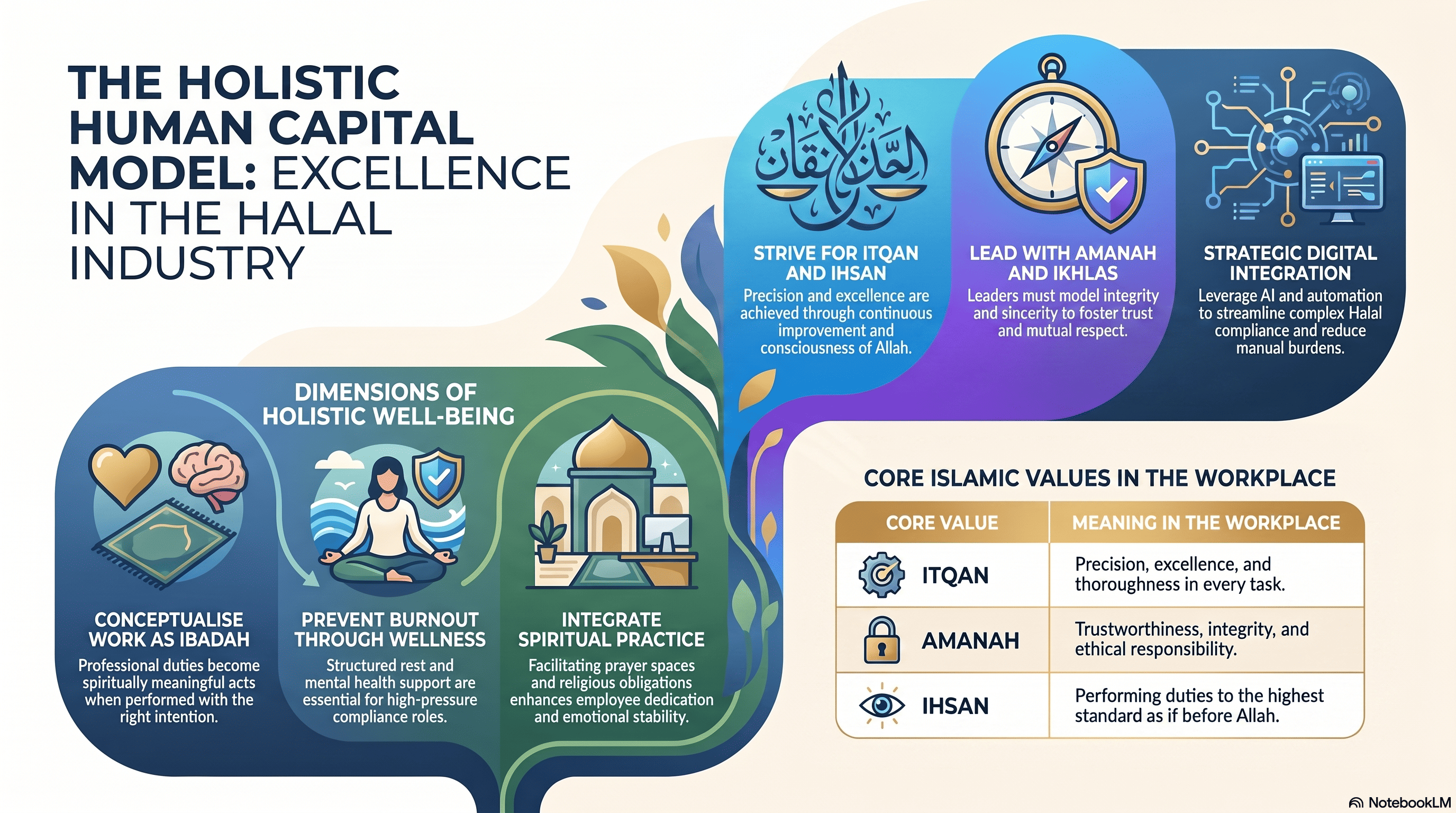
This study examines holistic human capital development in the Halal industry by integrating spiritual, physical, and mental well-being with organizational excellence. It highlights the role of Islamic values—such as amanah, ihsan, and itqan—in shaping ethical, purpose-driven work practices. The study addresses key workforce challenges, including skill gaps, regulatory complexity, and workplace demands, while proposing strategic approaches such as continuous training, wellness initiatives, and technological integration. The findings suggest that aligning professional practices with spiritual principles enhances productivity, resilience, and sustainable growth within the Halal ecosystem.
Downloads
References
Aini, Q., Talib, S. G., Alghazali, T., Ali, M. H., Sahi, Z. T., Kumar, T., Muda, I., Ramírez-Coronel, A. A., & Sunarsi, D. (2023). Spiritual intelligence, spiritual health and occupational stress in Islamic organisations. HTS Teologiese Studies / Theological Studies, 79(1). https://doi.org/10.4102/hts.v79i1.8228
Ajayi, F. A., & Udeh, C. A. (2024). Combating burnout in the IT industry: A review of employee well-being initiatives. International Journal of Applied Research in Social Sciences, 6(4), 567–588. https://doi.org/10.51594/ijarss.v6i4.1010
Alifah, A., & Sukmawati, A. (2022). Significant role of Islamic work ethic in Islamic banking: A systematic literature review and direction for future research. Al Tijarah, 8(1), 27–40. https://doi.org/10.21111/tijarah.v8i1.7415
Azmi, N. A. N., Noor, N. M., Elgharbawy, A. A. M., & Darmawan, N. (2024). Combining science and faith for better quality and safety in halalan toyyiban products. Halal Studies and Society, 1(3), 12–14. https://doi.org/10.29244/hass.1.3.12-14
El-Sherbeeny, A. M., Alsetoohy, O., Sheikhelsouk, S., Liu, S., & Kamar, M. A. (2024). Enhancing hotel employees’ well-being and safe behaviors: The influences of physical workload, mental workload, and psychological resilience. Oeconomia Copernicana, 15(2), 765–807. https://doi.org/10.24136/oc.3018
Florez-Jimenez, M. P., Lleó, Á., Ruiz-Palomino, P., & Rey, C. (2024). How to make organizations highly resilient: The role of purpose-driven leadership and shared purpose. Academy of Management Proceedings, 2024(1). https://doi.org/10.5465/amproc.2024.14975abstract
Handayati, P., Rochayatun, S., & Meldona. (2024). Halal food certification and sustainability performance: A conceptual paper. KnE Social Sciences. https://doi.org/10.18502/kss.v9i4.15064
Hutasuhut, J., Syamsuri, Abd. R., Saragih, A. R. S. A., & Sarkum, S. (2021). Islamic work ethics in management performance perspectives: Conceptualization and value internalization. In Routledge eBooks (pp. 88–93). Informa. https://doi.org/10.1201/9781003189282-15
Islam, R., & Ashton, A. S. (2024). The development of halal well-being experience quality: A conceptual framework. Information Management and Business Review, 16, 111–118. https://doi.org/10.22610/imbr.v16i3(i)s.3961
Karudin, K. M., Shaharudin, M. R., Zainoddin, A. I., & Moryadee, C. (2024). Halal logistics, halal manufacturing, competitiveness and halal organizational sustainability: A conceptual exploration. Information Management and Business Review, 16, 1001–1011. https://doi.org/10.22610/imbr.v16i3(i)s.3977
Mukri, M., Hanif, H., & Wakhid, A. A. (2024). Human resource ethics and professionalism: An Islamic perspective. KnE Social Sciences. https://doi.org/10.18502/kss.v9i16.16235
Murphy, K. A. (2024). Assessment of employee well-being on organisational effectiveness and productivity: A literature review. International Journal of Business and Management, 19(3), 26. https://doi.org/10.5539/ijbm.v19n3p26
Mutiarni, R., Salim, U., Sukoharsono, E. G., & Mintarti. (2022). Islamic human capital. In Advances in Economics, Business and Management Research (pp. 696–700). Atlantis Press. https://doi.org/10.2991/978-94-6463-008-4_87
Nurjaman, U., Mighwar, M. A., Harun, M., Mu’min, U. A., & Syaie, A. N. K. (2022). Quality assurance Islamic perspective: An alternative in Islamic-based public education institutions. Cendekia Jurnal Kependidikan Dan Kemasyarakatan, 1(1), 105–130. https://doi.org/10.21154/cendekia.v1i1.3986
Piwowar‐Sulej, K., Malik, S., Shobande, O. A., Singh, S., & Dagar, V. (2023). A contribution to sustainable human resource development in the era of the COVID-19 pandemic. Journal of Business Ethics, 191(2), 337–355. https://doi.org/10.1007/s10551-023-05456-3
Raies, A. (2021). Islamic work ethics as a key engine of endogenous economic growth. Islamic Economic Studies, 29(2), 86–99. https://doi.org/10.1108/IES-02-2021-0009
Rossouw, J. G., Herlofson, J., Geldenhuys, D. J., & Erieau, C. L. (2024). High adversity resilience training (HART): Development for emergency responders and defence. Journal of Applied Neurosciences, 3(1). https://doi.org/10.4102/jan.v3i1.8
Sari, S. P., Muis, A. R. C., Amatillah, M., & Janitra, N. T. (2023). Development of halal value chain as a manifestation for economy recovery in post COVID-19. Dauliyah Journal of Islamic and International Affairs, 8(2), 151–163. https://doi.org/10.21111/dauliyah.v8i2.10523
Sari, T. M., & Dini, W. (2023). Risk assessment and mitigation strategy in the halal broiler supply chain. Jurnal Riset Ilmu Teknik, 1(1), 13–24. https://doi.org/10.59976/jurit.v1i1.5
Susihono, W., Ridwan, A., & Alhamidi, A. (2021). Controlling risks through ergonomics participatory in industry of processed meat products certified halal. International Journal of Supply Chain Management, 10(1), 62–68. https://ojs.excelingtech.co.uk/index.php/IJSCM/article/download/5690/2995
Voak, A., & Fairman, B. (2021). Building human capability to ensure halal supply chain compliance. In Routledge eBooks (pp. 1–6). Informa. https://doi.org/10.1201/9781003189282-1
Voak, A., Fairman, B., & Wahyuni, H. C. (2023). Halal supply chain competencies. Journal of Resilient Economies, 3(2). https://doi.org/10.25120/jre.3.2.2023.4021
Westover, J. (2024). Inspiring purpose: How defining a clear why drives organizational success. Human Capital Leadership, 15(4). https://doi.org/10.70175/hclreview.2020.15.4.5
Downloads
Published
How to Cite
Issue
Section
License
Copyright (c) 2025 Yasmin Hanani Md Safian

This work is licensed under a Creative Commons Attribution-NonCommercial-ShareAlike 4.0 International License.