Halal Talent Development: Meeting the Global Demand for Skilled Professionals
DOI:
https://doi.org/10.55265/halalreviews.v5i1.139Keywords:
Halal Industry, Interdisciplinary Learning, Curriculum Development, Halal DevelopmentAbstract
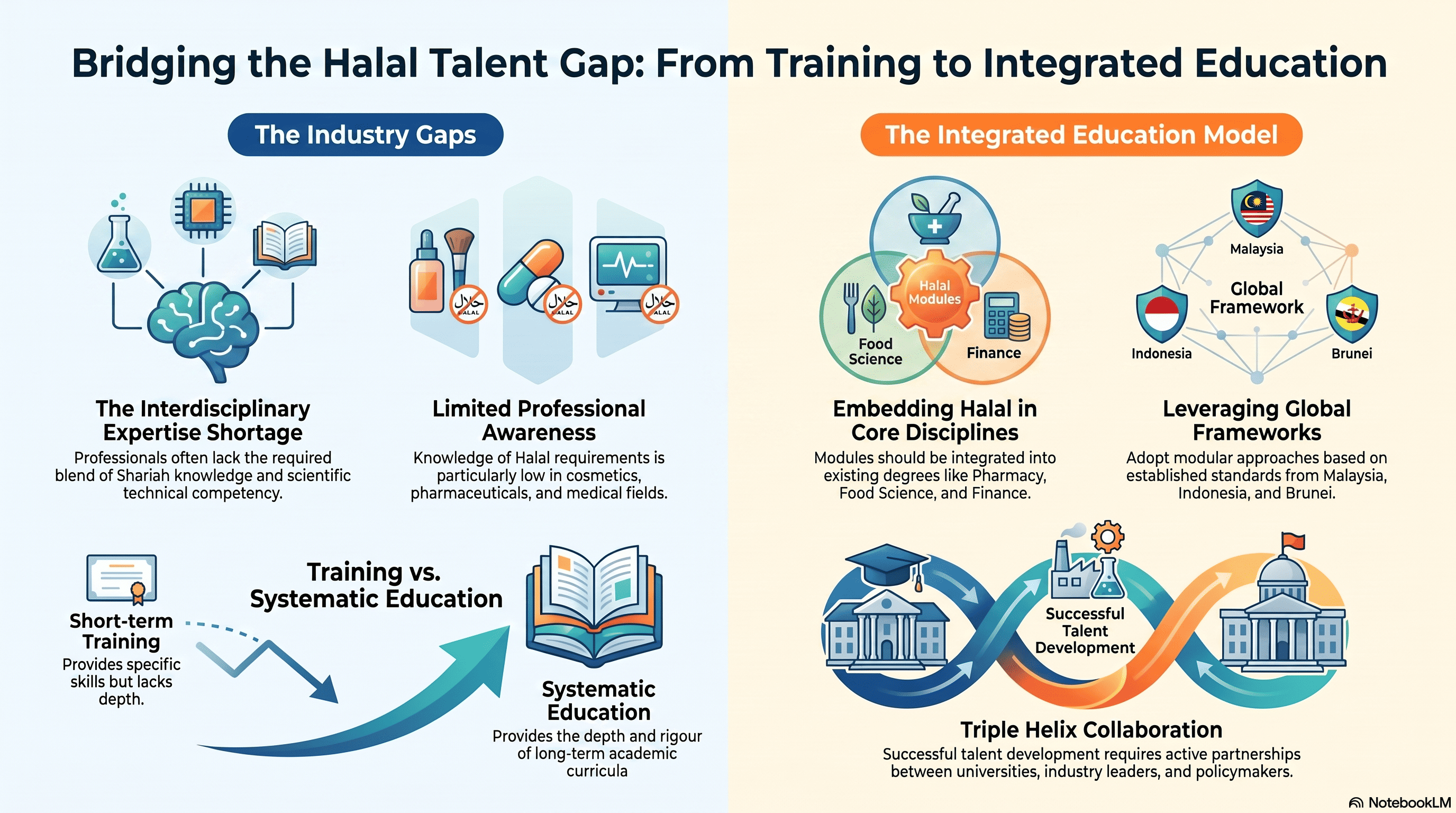
This study examines the gap between the rapid growth of the global Halal industry and workforce readiness, highlighting the role of higher education. It identifies key challenges, including limited interdisciplinary expertise, low awareness, and weak integration of Shariah and technical knowledge. The study argues that reliance on short-term training is insufficient and proposes embedding Halal knowledge within existing academic disciplines. Drawing on examples from Malaysia, Indonesia, and Brunei, it emphasizes the need for interdisciplinary curricula and stronger collaboration among academia, industry, and policymakers. The findings suggest that integrated education is essential for developing a competent and future-ready Halal workforce.
Downloads
References
Aldabbas, H., Gianni, M., & Alzoukani, A. (2026). Vocational education quality and students’ satisfaction: An empirical analysis in the UAE context. Quality Education for All, 3(1), 91–110. https://doi.org/10.1108/QEA-12-2024-0149
Alserhan, B. A., Bayırlı, M., & Zakzouk, F. (2020). Awareness towards halal pharmaceuticals: An analysis of pharmacists’ views. International Journal of Islamic Marketing and Branding, 5(1), 43. https://doi.org/10.1504/IJIMB.2020.109065
Azam, M. S. E., & Abdullah, M. A. (2020). Global halal industry: Realities and opportunities. International Journal of Islamic Business Ethics, 5(1), 47–59. https://doi.org/10.30659/ijibe.5.1.47-59
Azmi, N. A. N., Noor, N. M., Elgharbawy, A. A. M., & Darmawan, N. (2024). Combining science and faith for better quality and safety in halalan toyyiban products. Halal Studies and Society, 1(3), 12–14. https://doi.org/10.29244/hass.1.3.12-14
Bastian, R. A., & Fitri, C. D. (2025). Analisis kebijakan pemerintah dalam mendukung perkembangan industri halal: A systematic literature review. Desultanah Journal Education and Social Science, 3(2), 95–104. https://doi.org/10.69548/d-jess.v3i2.50
Benchikh, A., & Asmi, N. (2024). Ethics of training. Journal for Educators, Teachers and Trainers, 15(1). https://doi.org/10.47750/jett.2024.15.01.011
Busari, S. A., & Sitiris, M. (2021). Standardisation of halal industry towards sustainable development goals (SDG) [Penyeragaman industri halal ke arah matlamat pembangunan yang mampan (SDG)]. Journal of Islam in Asia, 18(1), 163–198. https://doi.org/10.31436/jia.v18i1.1001
Elicano, M. L. L. (2024). Knowledge, attitude, and practices (KAP) in complementary and alternative medicine (CAM) among selected Asian countries: A literature review. International Journal of Current Science Research and Review, 7(6). https://doi.org/10.47191/ijcsrr/v7-i6-22
Esmail, A. H. M. S., & Khan, Z. M. (2024). Alignment of vocational education curricula with job requirements in industrial sector: Analysis study. World Journal of Advanced Research and Reviews, 21(3), 2303–2313. https://doi.org/10.30574/wjarr.2024.21.3.1002
Hamzah, S. N., Yunus, F. A. N., Razali, N., Rahim, M. B., & Abdul Rahman, K. A. (2022). Development of an educational video of air conditioning workshop practice using the YouTube platform. https://doi.org/10.30880/ritvet.2022.02.02.030
Ibrahim, M. I., Jamaludin, M. A., Saffinee, S. S., Muflih, B. K., Zubairi, A. M., & Hashim, Y. Z. H.-Y. (2021). Development of framework for Malaysian halal industry education ecosystem. International Islamic University Malaysia Repository.
Ibrahim, M. I., Jamaludin, M. A., Zubairi, A. M., Muflih, B. K., & Hashim, Y. Z. H.-Y. (2022). Development of framework for halal studies program evaluation. Halalsphere, 2(1), 98–105. https://doi.org/10.31436/hs.v2i1.28
Jaber, D., Hasan, H. E., Alkaderi, A., Alkilani, A. Z., & El-Sharif, A.-R. (2024). Assessment of the knowledge, attitude, and perception of healthcare providers regarding halal pharmaceuticals. The Open Public Health Journal, 17(1). https://doi.org/10.2174/0118749445296459240322064212
Jaber, D., Salman, N., Tabbah, S. A., El-Sharif, A.-R., Alkilani, A. Z., & Qourshah, A. (2025). Evaluating the knowledge, attitude, and practices of Jordanian society towards halal pharmaceuticals. The Open Public Health Journal, 18(1). https://doi.org/10.2174/0118749445359631250105142907
Machmud, A., & Widuhung, S. D. (2024). The future of the global halal products and services ecosystem. International Journal of Religion, 5(10), 5257–5264. https://doi.org/10.61707/dz6xht33
Muawanah, Fauziah, N. D., Ainia, I. Z., Sari, D. T., & Fadlulloh, M. Y. (2026). Indonesia’s halal food industry: Development and challenges in achieving global hub status. Create Journal of Islamic Management and Business, 2(1), 48–67. https://doi.org/10.59373/create.v2i1.244
Muharni, Y., Ridwan, A., Athoilah, M. A., Rakhmawan, I., & Santoso, S. (2025). Key driver identification of halal industry ecosystem growth: A systematic literature review. Iqtishaduna International Conference Proceeding, 1, 73–78. https://doi.org/10.54783/20wphf67
Noviyanti, R., & Hakim, R. (2025). Halal industry growth: Economic opportunities and challenges in global markets. Jurnal Ilmu Ekonomi Dan Bisnis Islam, 7(1), 18–42. https://doi.org/10.24239/jiebi.v7i1.353.18-42
Nusran, M., & Sitnah. (2023). The paradigm of halal works: Road to an integrated production system. Journal of Advanced Research in Applied Sciences and Engineering Technology, 33(1), 490–507. https://doi.org/10.37934/araset.33.1.490507
Prawiro, A., & Fathudin, F. (2023). Challenges in the halal industry ecosystem: Analyzing the halal certification process for micro, small, and medium enterprises in Lombok, West Nusa Tenggara. Mazahib, 22(2), 431–484. https://doi.org/10.21093/mj.v22i2.7010
Prayuda, D., Arby, S., Adli, I., & Al-Ayubi, S. (2023). Halal industry: Opportunities and challenge in the global market. Al-Infaq Jurnal Ekonomi Islam, 14(2), 267. https://doi.org/10.32507/ajei.v14i2.2376
Risza, H. (2024). The role of universities in pioneering halal product innovation and education in Indonesia. Al-Ishlah: Jurnal Pendidikan, 16(2), 821–829. https://doi.org/10.35445/alishlah.v16i2.5218
Saaidun, N. S. N., Ariffin, A. S., Jamil, A. I., & Nor, N. F. (2025). Fostering sustainable partnership in the halal sector: A triple helix model for enhanced food security and graduate employability. KnE Social Sciences, 10(24), 25–35. https://doi.org/10.18502/kss.v10i24.19801
Sakinah, A. R. N., Zawani, M. S. N., & Zalina, Z. (2025). An evaluation of halal talent development implementation: Issues and challenges faced by halal training providers in Malaysia. University of Malaya Research Repository.
Voak, A., Fairman, B., & Wahyuni, H. C. (2023). Halal supply chain competencies. Journal of Resilient Economies, 3(2). https://doi.org/10.25120/jre.3.2.2023.4021
Wafiyah, U. (2025). The role of Islamic higher education in developing human resources for the global halal industry: Synchronizing curriculum. ETDC Indonesian Journal of Research and Educational Review, 4(4), 1778–1790. https://doi.org/10.51574/ijrer.v4i4.4073
Downloads
Published
How to Cite
Issue
Section
License
Copyright (c) 2025 Alina Abdulrahim

This work is licensed under a Creative Commons Attribution-NonCommercial-ShareAlike 4.0 International License.